


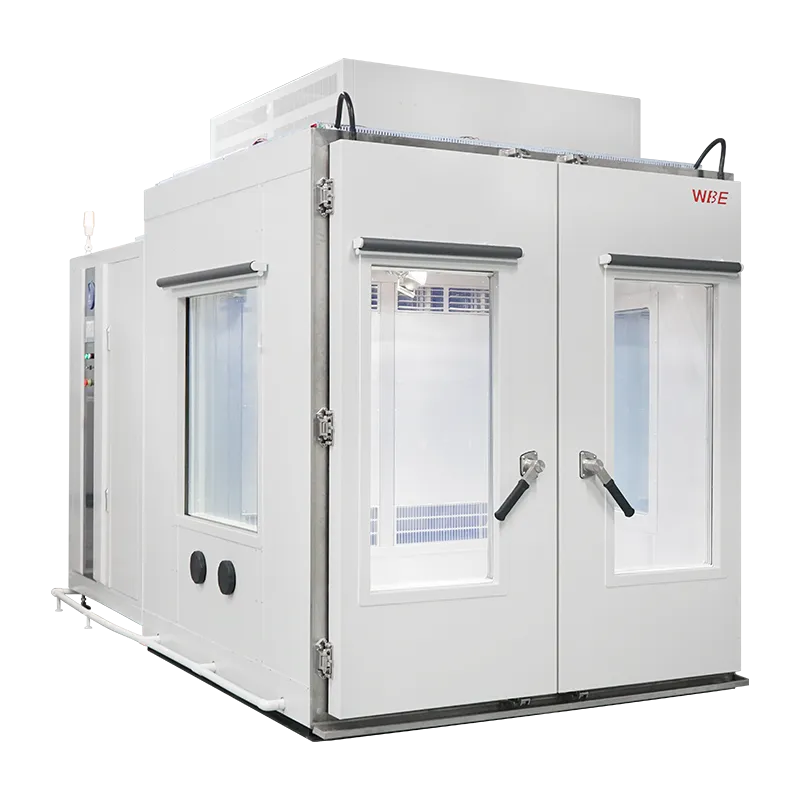
Industrial equipment and systems are increasingly complex, requiring thorough testing to ensure reliability, safety, and performance under extreme environmental conditions. Walk-in Environmental Chambers are a critical solution for industrial reliability testing, providing spacious, controlled environments for full-scale product and system evaluations.
Unlike standard environmental chambers, walk-in chambers can accommodate large machinery, automotive components, electronic cabinets, or entire assemblies. This capability enables engineers and quality teams to simulate real-world conditions, verify performance, and identify potential failures before deployment.
Why Walk-in Environmental Chambers Are Essential for Industrial Testing
In industrial applications, testing small samples alone cannot provide a complete understanding of how products will perform under operational stress. Large systems often include multiple integrated components, where interactions between parts may impact reliability. Walk-in Environmental Chambers allow full-scale testing, providing insights that cannot be achieved with conventional chambers.
Key reasons industrial testing benefits from walk-in chambers include:
- Large test area for equipment, assemblies, or full systems
- Controlled temperature and humidity for accurate simulation of real-world conditions
- Ease of monitoring and access for technicians during testing
- Ability to perform long-duration and repetitive testing cycles
Walk-in chambers enable manufacturers to validate the durability, thermal performance, and environmental resistance of industrial products under controlled yet realistic conditions.
Key Benefits of Walk-in Environmental Chambers
1. Full-Scale Product Testing
Walk-in chambers accommodate large or complex systems, such as industrial machinery, control cabinets, automotive assemblies, or energy storage systems. Full-scale testing ensures that interactions between components are accounted for, providing a more accurate evaluation of overall product reliability.
2. Accurate Environmental Simulation
These chambers can precisely regulate temperature, humidity, and airflow to replicate extreme industrial environments. This is particularly important for industries where equipment is exposed to high or low temperatures, humidity, or fluctuating conditions.
3. Improved Reliability Evaluation
By simulating realistic operating environments, walk-in chambers help engineers identify weaknesses in materials, designs, and thermal management systems. This enables proactive improvements and reduces the risk of unexpected failures in the field.
4. Versatile Applications
Walk-in chambers are used in multiple industries, including:
- Automotive manufacturing: testing engines, electronics, and complete vehicle components
- Aerospace: evaluating systems under thermal stress and humidity extremes
- Electronics: assessing large electronic assemblies, control panels, and energy storage modules
- Industrial equipment: validating machinery durability, thermal management, and environmental resistance
5. Enhanced Safety and Monitoring
Equipped with alarms, data logging, and emergency stop systems, walk-in chambers provide a safe testing environment. Real-time monitoring allows technicians to track test parameters and intervene if necessary, ensuring both personnel safety and product integrity.
Maintenance and Operational Tips
To maximize performance and longevity, walk-in chambers require regular maintenance:
- Regular Cleaning: Keep walls, floors, and airflow systems free of dust or debris
- Sensor Calibration: Periodically calibrate temperature and humidity sensors to maintain accuracy
- System Inspection: Check refrigeration, heating, and airflow components regularly
- Data Verification: Ensure monitoring systems and data logs are functioning correctly
Proper maintenance ensures consistent results, minimizes downtime, and extends equipment lifespan.
About WBE Instrument Technology
Guangdong WBE Instrument Technology Co., Ltd. is a leading manufacturer of environmental and mechanical testing equipment. Since 1995, WBE has focused on designing advanced solutions including Walk-in Environmental Chambers, Rapid Rate Temperature Exchange Chambers, Thermal Shock Test Chambers, Environmental Test Chambers, and Universal Testing Machines.
WBE serves a broad range of industries, including automotive, aerospace, electronics, and industrial manufacturing. With precise environmental control, reliable performance, and expert technical support, WBE helps companies perform accurate industrial reliability testing and optimize product durability.
FAQ
Q1: What is a Walk-in Environmental Chamber?
A Walk-in Environmental Chamber is a large testing facility that allows full-size products or systems to be tested under controlled temperature, humidity, and environmental conditions.
Q2: Why are walk-in chambers important for industrial reliability testing?
They provide realistic testing conditions for large systems, enabling engineers to identify weaknesses and improve overall product performance.
Q3: Which industries commonly use walk-in chambers?
Industries such as automotive, aerospace, electronics, and heavy machinery frequently use walk-in chambers for large-scale reliability testing.
Q4: Can walk-in chambers simulate both temperature and humidity?
Yes, they allow precise control of temperature, humidity, and airflow, often with programmable cycles for complex environmental simulations.
Q5: How can walk-in chambers improve product safety?
By accurately replicating extreme operational conditions, they help identify potential failures and thermal risks, enhancing product safety before field deployment.