


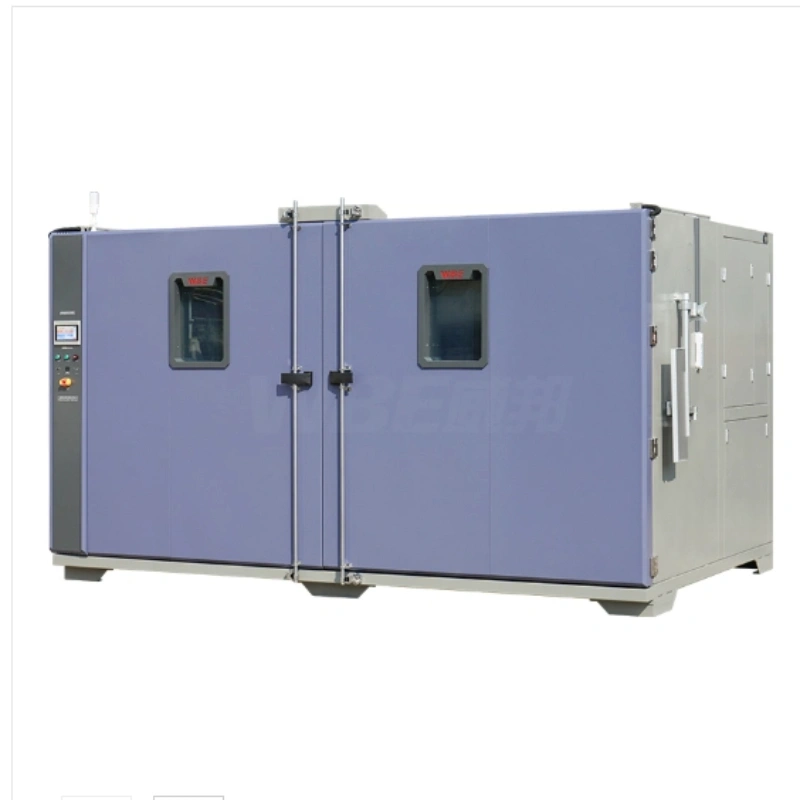
In the realm of advanced industrial manufacturing and quality assurance, the ability to simulate extreme environmental conditions is paramount. For large-scale products such as electric vehicle battery packs, aerospace components, and telecommunications infrastructure, standard benchtop testers are insufficient. This is where walk-in environmental chambers become indispensable. These massive testing enclosures provide the volume necessary to house full systems while maintaining a level of precision that rivals smaller laboratory units. However, achieving and maintaining stability within such a large footprint is an engineering marvel that relies on the synergy of high-performance air circulation, sophisticated refrigeration, and intelligent control logic.
Stability in an environmental chamber is defined by two primary metrics: uniformity and constancy. Uniformity ensures that the temperature and humidity levels are identical across every cubic inch of the interior space, while constancy ensures those levels do not fluctuate over time. For a manufacturer, even a minor deviation can lead to inaccurate test data, potentially resulting in product failure in the field or unnecessary redesigns. WBE has spent years refining the mechanics behind these systems to ensure that our walk-in environmental chambers deliver the most reliable data possible for global industries.
The Engineering of Air Circulation in Walk-in Environmental Chambers
The foundation of stability within walk-in environmental chambers is the air circulation system. Unlike small chambers where air can be moved easily, a walk-in room requires a high-volume, high-velocity air exchange system to prevent the formation of stagnant "dead zones." WBE utilizes heavy-duty centrifugal fans and custom-engineered ductwork to create a laminar airflow pattern. This design ensures that conditioned air is distributed evenly from the ceiling or side walls and returned through floor-level or opposite-wall vents, creating a continuous loop of thermal exchange.
The speed of the air movement must be carefully balanced. If the airflow is too slow, the temperature at the top of the chamber may differ significantly from the bottom due to heat stratification. Conversely, if the airflow is too turbulent, it can interfere with sensitive sensors or create localized hotspots. Advanced walk-in environmental chambers employ variable frequency drives (VFDs) for fan control, allowing the system to adjust the volume of air based on the current load inside the chamber. This adaptability is critical when testing large, heat-dissipating objects like running electronics or charging batteries, where the chamber must work harder to whisk away the heat generated by the test specimen itself.
Precision Refrigeration and Balanced Temperature Control
Maintaining a setpoint requires a delicate dance between heating and cooling. Modern walk-in environmental chambers do not simply cycle a compressor on and off; such a binary approach would lead to massive temperature swings. Instead, WBE utilizes a Balanced Temperature Control (BTC) system. In this setup, the refrigeration system runs continuously at a modulated capacity, while the heating elements provide fine-tuned adjustments to maintain a perfectly flat setpoint line. This method provides the rapid response necessary to counteract external ambient changes or internal heat loads.
The refrigeration hardware in walk-in environmental chambers often consists of multi-stage compressors and electronic expansion valves (EEV). The EEV is a critical component for stability, as it precisely controls the flow of refrigerant into the evaporator, allowing the system to match the cooling output to the actual demand. Furthermore, high-quality stainless steel heaters are strategically positioned within the air plenum to ensure that the air is warmed immediately before it enters the testing zone. This real-time modulation is what allows walk-in environmental chambers to maintain stability within tolerances as tight as plus or minus 0.5 degrees Celsius, even in rooms large enough to park a vehicle.
Sophisticated Humidification Systems for Humidity Stability
Humidity is significantly more difficult to stabilize than temperature because it is highly sensitive to thermal fluctuations. In walk-in environmental chambers, moisture is typically introduced via a steam generator or an ultrasonic humidification system. The challenge lies in distributing this moisture without causing condensation on the walls or the test specimen. WBE integrates high-precision capacitive humidity sensors or electronic wet/dry bulb sensors that provide instantaneous feedback to the controller. By monitoring the dew point, the system can determine exactly how much water vapor needs to be added or removed.
Dehumidification is equally vital for stability, especially when simulating arid environments. This is achieved by passing the chamber air over a dedicated cooling coil that strips moisture out through condensation. For extremely low humidity requirements, desiccant wheel dryers may be integrated into the walk-in environmental chambers. The integration of these components ensures that the relative humidity (RH) remains stable, usually within a range of plus or minus 2.5% to 5% RH. Proper sealing of the chamber is also a prerequisite; any ingress of ambient air can introduce unwanted moisture, which is why WBE uses multi-layered silicone door gaskets and pressure-sealed cable ports.
The Role of Cabinet Construction and Insulation
The external shell of walk-in environmental chambers acts as the primary barrier against the laboratory's ambient conditions. Without high-performance insulation, the heating and cooling systems would be in a constant state of overcompensation, leading to instability. WBE constructs these chambers using high-density polyurethane foam panels, typically between 100mm and 150mm thick, sandwiched between stainless steel or coated steel plates. This modular construction provides an exceptional R-value, ensuring that the interior climate remains isolated from the outside world.
Furthermore, the thermal bridge design is a key focus during the construction of walk-in environmental chambers. A thermal bridge is any point where heat can easily transfer through the insulation, such as metal-to-metal contact points in the door frame or floor. WBE employs specialized non-metallic breaks to eliminate these bridges. The floor of the chamber is often reinforced with high-strength materials to support heavy test loads while maintaining its insulating properties. These structural details are what prevent localized cold spots that could otherwise trigger condensation or temperature gradients, thereby reinforcing the overall stability of the testing environment.
Smart Controllers: The Brains Behind the Stability
Even the best hardware is ineffective without a sophisticated control system to manage it. The controllers used in modern walk-in environmental chambers utilize Proportional-Integral-Derivative (PID) logic. This mathematical algorithm constantly calculates the difference between the desired setpoint and the actual measured value, adjusting the output of the heaters and compressors accordingly. WBE uses high-resolution touch-screen controllers that allow users to program complex multi-step profiles, simulating realistic environmental cycles such as a desert day-night transition.
In addition to basic PID control, advanced walk-in environmental chambers feature fuzzy logic and predictive modeling. These systems can "learn" how the chamber responds to certain loads and preemptively adjust the cooling or heating before a deviation occurs. Remote monitoring capabilities also allow engineers to track the stability of the chamber from a centralized computer or mobile device. This level of oversight ensures that if any component deviates from its optimal performance, an alarm is triggered immediately, protecting the integrity of the test and the valuable assets inside.
Why Choose WBE for Your Testing Needs?
At WBE (Guangdong Yuanyao Test Equipment Co., Ltd.), we specialize in providing high-end environmental testing solutions that meet the rigorous demands of modern industry. Our expertise in thermodynamic engineering allows us to design and manufacture walk-in environmental chambers that provide unmatched stability and reliability. We understand that every testing requirement is unique, which is why we offer a diverse range of products tailored to sectors like new energy, semiconductors, and automotive manufacturing.
Our competitive advantage lies in our commitment to quality and innovation. From our walk-in temperature and humidity test chamber designed for large-scale stability to our specialized walk-in battery explosion-proof chambers, we ensure that safety and precision go hand-in-hand. When you partner with WBE, you gain access to a team of experts dedicated to helping you achieve international quality standards through robust reliability testing.
Explore our full catalog of environmental testing products to find the perfect fit for your laboratory or production line. We invite you to learn more about why WBE is a leading manufacturer in the environmental test chamber industry.
Conclusion
Maintaining temperature and humidity stability in walk-in environmental chambers is a complex task that requires the perfect integration of air circulation, refrigeration, humidification, and intelligent control systems. By focusing on uniform airflow and high-performance cabinet construction, these large-scale chambers provide the stable conditions necessary for critical reliability testing. As industries continue to push the boundaries of product durability, the role of high-quality walk-in chambers will only become more significant.
Ready to elevate your testing capabilities?
Contact our technical experts today for a customized quote on our walk-in environmental chambers.
Contact WBE NowFrequently Asked Questions
Q1: What is the typical temperature range of walk-in environmental chambers?
Most industrial walk-in environmental chambers offer a standard temperature range from -70 degrees Celsius to +150 degrees Celsius. However, custom configurations can be designed to reach higher or lower extremes depending on the specific requirements of the product being tested, such as aerospace components or new energy vehicle batteries.
Q2: How often should walk-in environmental chambers be calibrated for stability?
To ensure continued stability and accuracy, walk-in environmental chambers should be calibrated at least once a year. In high-stakes industries like medical device manufacturing or automotive safety testing, semi-annual calibration may be required to comply with ISO or other international quality standards.
Q3: Can walk-in environmental chambers handle active heat loads from test specimens?
Yes, high-quality walk-in environmental chambers are specifically designed to handle active heat loads. This is achieved by increasing the refrigeration capacity and fan speed to effectively neutralize the heat generated by electronics, motors, or batteries during operation within the chamber.
Q4: What are the installation requirements for walk-in environmental chambers?
Installation of walk-in environmental chambers requires a level floor capable of supporting significant weight, a reliable power supply (often three-phase), a water source for humidification, and adequate drainage. Additionally, there must be sufficient space around the exterior for ventilation of the refrigeration system.
Q5: How do walk-in environmental chambers ensure user safety during operation?
Safety is a priority in the design of walk-in environmental chambers. They are equipped with internal emergency release handles, pressure relief vents, audible and visual alarms, and oxygen sensors. For battery testing, additional explosion-proof features such as fire suppression systems and blow-out panels are integrated.