


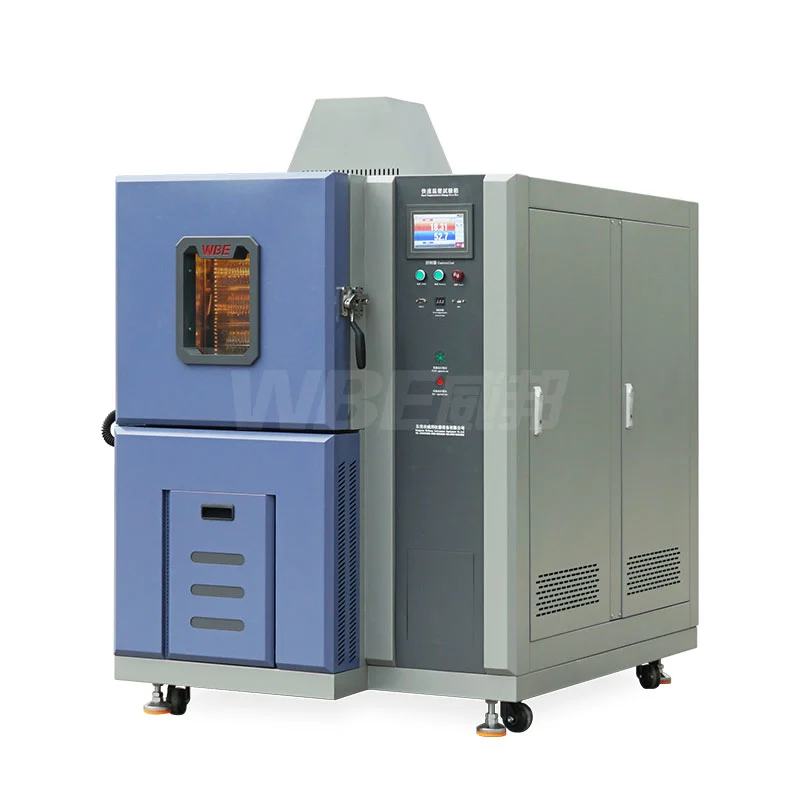
Rapid Rate Temperature Exchange Chamber: Accelerating Product Validation
As product development cycles continue to shorten across global industries, manufacturers are under increasing pressure to validate performance, reliability, and durability in less time—without sacrificing accuracy. Traditional environmental testing methods often struggle to keep pace with these demands, especially when products must withstand rapid and repeated temperature changes in real-world use.
A Rapid Rate Temperature Exchange Chamber is designed specifically to address this challenge. By enabling fast, controlled temperature transitions, it allows engineers to expose products to severe thermal stress in a compressed timeframe. This capability significantly improves product validation speed while delivering deeper insights into potential failure mechanisms.
This article explains how Rapid Rate Temperature Exchange Chambers improve product validation efficiency, explores their typical applications in electronics, automotive, and aerospace testing, and provides practical guidance on selecting the right temperature ramp rate based on test standards and product requirements.
1. How Rapid Rate Temperature Exchange Chambers Improve Product Validation Speed
Product validation is not just about meeting specifications—it is about identifying weaknesses early, reducing design iterations, and accelerating time-to-market. A Rapid Rate Temperature Exchange Chamber plays a critical role in achieving these goals.
1.1 Faster Thermal Cycling and Shorter Test Programs
One of the most significant advantages of a Rapid Rate Temperature Exchange Chamber is its ability to achieve high temperature ramp rates, often ranging from 5 °C/min to over 20 °C/min, depending on system configuration.
Compared with standard temperature chambers, which typically operate at 1–3 °C/min, rapid-rate chambers can:
- Complete thermal cycling tests in a fraction of the time
- Reduce multi-day test programs to hours
- Enable more test iterations within the same development window
This acceleration allows engineers to validate designs earlier and move faster toward production readiness.
1.2 Early Detection of Latent Design and Material Issues
Rapid temperature changes introduce intense thermal stress, which accelerates failure mechanisms such as:
- Differential thermal expansion between materials
- Micro-cracking in housings or coatings
- Fatigue in solder joints, welds, and mechanical interfaces
By using a Rapid Rate Temperature Exchange Chamber, these weaknesses are revealed much earlier than with slow, gradual temperature testing. Early detection minimizes costly redesigns late in the development cycle.
1.3 Improved Decision-Making in Product Development
Faster validation cycles enable data-driven decisions at critical project milestones. Engineers can:
- Compare alternative materials or designs under identical stress conditions
- Quickly verify corrective actions after design changes
- Confidently approve products for the next development stage
In competitive markets, the ability to validate faster often translates directly into commercial advantage.
2. Typical Applications in Electronics, Automotive, and Aerospace Testing
Due to their performance and flexibility, Rapid Rate Temperature Exchange Chambers are widely used across industries where products are exposed to dynamic thermal environments.
2.1 Electronics and Semiconductor Testing
Electronics are particularly sensitive to temperature variation due to the interaction of different materials within compact assemblies. Typical applications include:
- Printed circuit board (PCB) thermal cycling
- Semiconductor package reliability testing
- Connector, sensor, and module validation
A Rapid Rate Temperature Exchange Chamber helps manufacturers evaluate how electronic assemblies respond to repeated thermal stress, reducing the risk of early-life failures in mass production.
2.2 Automotive and New Energy Vehicle Testing
Automotive components must operate reliably across extreme temperature ranges, often under rapid transitions such as cold starts or engine heat exposure. Common test objects include:
- Electronic control units (ECUs)
- Battery packs and power modules
- Automotive sensors and connectors
Rapid temperature exchange testing enables automotive manufacturers and suppliers to meet stringent reliability and safety standards while shortening validation timelines.
2.3 Aerospace and Defense Applications
Aerospace products experience some of the most severe thermal environments, including rapid temperature changes during ascent, descent, and space operation. Applications include:
- Avionics systems
- Structural materials and composites
- Aerospace-grade electronic components
In these high-risk environments, a Rapid Rate Temperature Exchange Chamber provides critical assurance that products can withstand extreme thermal stress without performance degradation.
Table: Typical Industry Applications and Test Focus
|
Industry |
Typical Test Objects |
Test Focus |
|
Electronics |
PCBs, chips, connectors |
Thermal fatigue, solder joint reliability |
|
Automotive |
ECUs, batteries, sensors |
Durability, safety, lifecycle validation |
|
Aerospace |
Avionics, composites |
Extreme stress resistance, reliability |
3. How to Choose the Right Temperature Ramp Rate for Your Test Standards
Selecting the appropriate temperature ramp rate is essential to ensure meaningful test results without overstressing products beyond realistic conditions.
3.1 Understanding Product Operating Conditions
The first step in selecting a ramp rate is understanding how the product experiences temperature changes in actual use. Consider:
- Maximum and minimum operating temperatures
- Speed of temperature transitions in real environments
- Frequency of thermal cycling during product life
For example, consumer electronics may require moderate ramp rates, while automotive or aerospace components often demand more aggressive testing.
3.2 Aligning with Test Standards and Internal Specifications
Many international and industry-specific standards define temperature cycling requirements. While not all specify exact ramp rates, they often provide guidance on severity and test intent.
When choosing a ramp rate:
- Review applicable IEC, ISO, MIL, or automotive standards
- Consider internal corporate reliability specifications
- Balance test acceleration with realistic stress simulation
A Rapid Rate Temperature Exchange Chamber offers flexibility, allowing ramp rates to be tailored to different standards and product categories.
3.3 Avoiding Over-Testing and Misleading Results
While higher ramp rates accelerate testing, excessively aggressive conditions may introduce failure modes that are unlikely in real use. This can lead to:
- Over-engineering
- Increased product cost
- Misinterpretation of reliability data
An optimal ramp rate should accelerate real-world stress—not replace it with unrealistic extremes.
3.4 Flexibility for Multiple Test Scenarios
Manufacturers often test multiple products or variants on the same system. Choosing a Rapid Rate Temperature Exchange Chamber with adjustable ramp rates ensures:
- Compatibility with diverse test requirements
- Long-term equipment usability
- Better return on investment
Flexibility is especially important for testing laboratories and contract testing services.
4. Key Considerations When Selecting a Rapid Rate Temperature Exchange Chamber
Beyond ramp rate, several technical and operational factors influence system performance.
Important considerations include:
- Temperature uniformity during rapid transitions
- Control system stability and repeatability
- Chamber size and load capacity
- Customization for non-standard test conditions
A well-designed Rapid Rate Temperature Exchange Chamber balances speed, accuracy, and long-term reliability.
5. Why WBE Is a Trusted Partner for Rapid Temperature Exchange Solutions
As discussed throughout this article, achieving faster product validation requires more than just high ramp rates—it requires reliable equipment, precise control, and professional support.
Guangdong WBE Instrument Technology Co., Ltd. (WBE) specializes in the design and manufacture of advanced environmental testing equipment, including Rapid Rate Temperature Exchange Chambers tailored to demanding industrial applications. WBE’s systems are engineered to deliver:
- Stable and repeatable high temperature change rates
- Compliance with CE, RoHS, and relevant international standards
- Custom solutions for non-standard testing requirements
With over 12,000 square meters of modern manufacturing facilities, in-house machining and sheet metal production, and ISO9001 / ISO14001 certified quality management systems, WBE supports customers from system design to final delivery. Standard models can be delivered within 15–20 days, helping clients accelerate testing projects without delay.
Backed by a growing global service network, WBE continues to support electronics, automotive, aerospace, and industrial customers worldwide in achieving faster and more reliable product validation.
Conclusion
A Rapid Rate Temperature Exchange Chamber is a powerful tool for improving product validation speed while maintaining high reliability standards. By enabling rapid thermal cycling, uncovering latent failures early, and supporting industry-specific testing requirements, it plays a vital role in modern product development.
Choosing the right ramp rate—and the right equipment partner—ensures that accelerated testing delivers meaningful, actionable results. With its technical expertise and flexible solutions, WBE helps manufacturers move faster, test smarter, and build more reliable products.