


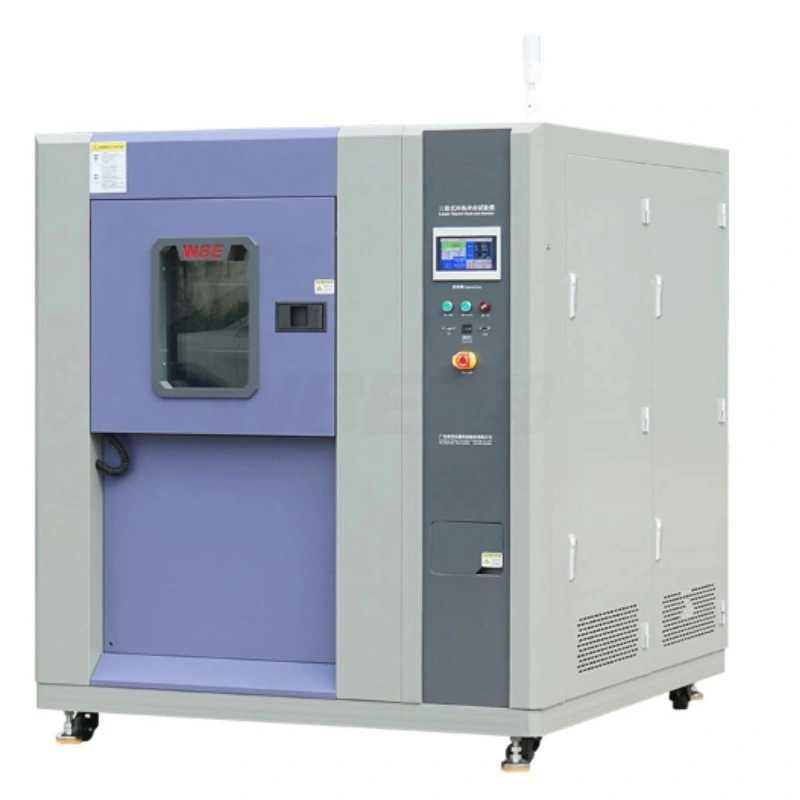
Thermal Shock Test Chamber: Revealing Hidden Reliability Risks
Modern products—especially in electronics, automotive, and aerospace industries—are expected to operate reliably under extreme and rapidly changing environments. However, many failures do not appear during normal operation or slow environmental testing. Instead, they occur when materials and assemblies are exposed to sudden, severe temperature changes.
This is where a Thermal Shock Test Chamber becomes essential. By transferring test specimens between extreme hot and cold environments in seconds, thermal shock testing exposes latent defects that conventional temperature tests often miss.
This article explains what a Thermal Shock Test Chamber is and why it is used, compares it with temperature cycling chambers, and explores why thermal shock testing is uniquely effective at revealing hidden material and design weaknesses.
1. What Is a Thermal Shock Test Chamber and Why It Is Used
A Thermal Shock Test Chamber is a specialized environmental testing system designed to subject products to sudden and extreme temperature changes. Unlike gradual heating or cooling, thermal shock testing creates instantaneous thermal stress that simulates the harshest real-world conditions.
1.1 Basic Working Principle of a Thermal Shock Test Chamber
Most Thermal Shock Test Chambers operate using either a two-zone or three-zone configuration:
- Hot zone maintained at elevated temperatures
- Cold zone maintained at sub-zero temperatures
- (Optional) Transfer zone for controlled specimen movement
During testing, the sample is rapidly transferred—often within seconds—from one temperature extreme to the other. This abrupt change generates intense thermal stress within materials, interfaces, and assemblies.
1.2 Why Thermal Shock Testing Is Necessary
Many products experience sudden temperature changes during actual use:
- Automotive electronics during cold starts
- Aerospace components moving between ground and high-altitude environments
- Electronic devices exposed to rapid power-on heating
A Thermal Shock Test Chamber reproduces these conditions in a controlled laboratory environment, allowing engineers to evaluate whether a product can survive abrupt thermal transitions without cracking, delamination, or functional failure.
2. Thermal Shock Test Chamber vs Temperature Cycling Chamber
Although both systems are used for temperature-related reliability testing, they serve fundamentally different purposes. Understanding this distinction is critical when selecting the right test method.
2.1 Temperature Change Method
The most significant difference lies in how temperature changes are applied:
- A Temperature Cycling Chamber changes temperature gradually, typically at a defined ramp rate (e.g., 1–5 °C/min).
- A Thermal Shock Test Chamber introduces near-instant temperature changes by physically moving samples between zones.
This difference directly affects the type and severity of stress imposed on the test specimen.
2.2 Stress Severity and Failure Mechanisms
Temperature cycling primarily evaluates long-term durability and fatigue, while thermal shock testing targets:
- Sudden thermal expansion and contraction
- Material interface mismatch
- Internal stress concentration
A Thermal Shock Test Chamber is therefore more effective at revealing structural and interfacial weaknesses that only occur under extreme stress.
2.3 Comparison Table
|
Aspect |
Thermal Shock Test Chamber |
Temperature Cycling Chamber |
|
Temperature change |
Instantaneous |
Gradual |
|
Stress intensity |
Very high |
Moderate |
|
Typical use |
Failure screening |
Durability evaluation |
|
Test duration |
Short |
Long |
|
Failure detection |
Early-stage defects |
Long-term fatigue |
3. Why Thermal Shock Testing Reveals Hidden Material and Design Defects
The true value of a Thermal Shock Test Chamber lies in its ability to expose problems that remain invisible under normal testing conditions.
3.1 Differential Thermal Expansion
Most products are made of multiple materials—metals, plastics, ceramics, composites—each with different coefficients of thermal expansion. Sudden temperature changes cause these materials to expand or contract at different rates, generating internal stress.
Thermal shock testing amplifies this effect, making it easier to detect:
- Cracks in housings or coatings
- Delamination in bonded interfaces
- Separation between dissimilar materials
3.2 Solder Joint and Interconnect Failures
In electronic assemblies, solder joints are especially vulnerable to rapid temperature changes. A Thermal Shock Test Chamber accelerates:
- Micro-crack formation
- Loss of electrical continuity
- Premature interconnect failure
These issues often pass standard functional tests but later cause field failures.
3.3 Design Weaknesses and Manufacturing Variations
Thermal shock testing also highlights:
- Poor structural design margins
- Inconsistent material quality
- Assembly process variations
Because thermal shock testing is unforgiving, it quickly separates robust designs from marginal ones.
4. Industries That Rely on Thermal Shock Test Chambers
Due to their ability to uncover early-stage failures, Thermal Shock Test Chambers are widely used in high-reliability industries.
4.1 Electronics and Semiconductor Industry
Applications include:
- Integrated circuits and chip packages
- PCBs and electronic modules
- Consumer electronics components
Thermal shock testing helps prevent costly recalls caused by latent defects.
4.2 Automotive and New Energy Vehicles
Automotive components are exposed to harsh temperature transitions during operation. Thermal Shock Test Chambers are commonly used for:
- ECUs and sensors
- Power electronics and battery systems
- Automotive connectors and control units
These tests support compliance with automotive reliability standards.
4.3 Aerospace, Defense, and Industrial Equipment
In aerospace and defense, failure is not an option. Thermal shock testing validates:
- Avionics systems
- Structural materials
- Mission-critical electronic assemblies
The Thermal Shock Test Chamber ensures components can withstand extreme environmental stress without failure.
5. Key Considerations When Selecting a Thermal Shock Test Chamber
Choosing the right Thermal Shock Test Chamber requires evaluating both technical and operational factors.
Important considerations include:
- Temperature range and transition time
- Chamber capacity and load weight
- Temperature uniformity in each zone
- Control system accuracy and repeatability
Flexibility and customization are also important for companies testing multiple product types.
6. Why WBE Is a Reliable Partner for Thermal Shock Testing Solutions
As shown throughout this article, effective thermal shock testing demands more than extreme temperatures—it requires precise control, repeatability, and reliable system design.
Guangdong WBE Instrument Technology Co., Ltd. (WBE) develops Thermal Shock Test Chambers engineered to meet the rigorous demands of electronics, automotive, aerospace, and industrial testing. WBE systems are designed to:
- Deliver fast and stable temperature transitions
- Maintain excellent temperature uniformity
- Support both standard and non-standard test requirements
With in-house manufacturing capabilities, certified quality systems, and global technical support, WBE helps customers implement reliable thermal shock testing that reveals hidden defects before products reach the market.
Conclusion
A Thermal Shock Test Chamber is an indispensable tool for identifying hidden material and design weaknesses that conventional testing cannot reveal. By subjecting products to extreme and instantaneous temperature changes, it exposes failure mechanisms early—saving time, cost, and reputation.
When paired with a technically capable and experienced supplier like WBE, thermal shock testing becomes a strategic advantage rather than a compliance burden.