


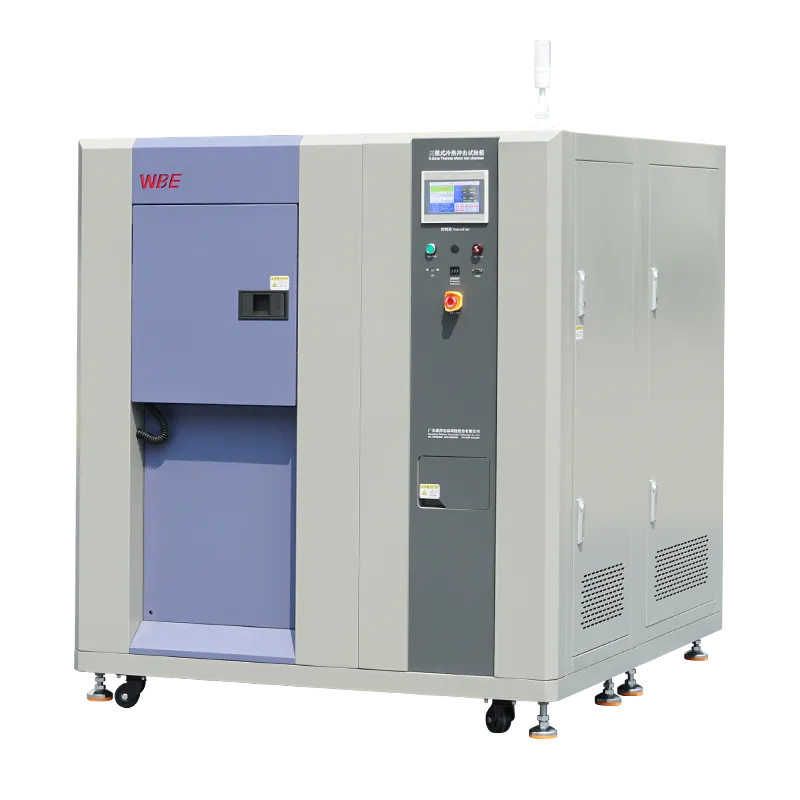
Thermal Shock Test Chamber: Simulating Extreme Environments and Revealing Failure Risks
Modern products are expected to perform reliably under increasingly harsh and unpredictable environmental conditions. From automotive electronics facing sudden cold starts to aerospace components exposed to rapid altitude changes, real-world applications often involve extreme temperature transitions that conventional testing cannot fully replicate.
A Thermal Shock Test Chamber is specifically designed to simulate these extreme conditions. By subjecting test specimens to abrupt and repeated temperature changes, it accelerates stress mechanisms that reveal hidden weaknesses in materials, assemblies, and designs.
This article explains how Thermal Shock Test Chambers simulate extreme environmental conditions, outlines the key parameters to consider when selecting the right system, and examines the most common failures detected through thermal shock testing.
1. How Thermal Shock Test Chambers Simulate Extreme Environmental Conditions
Thermal shock testing differs fundamentally from standard temperature testing. Instead of gradual heating or cooling, it focuses on instantaneous temperature transitions that create severe internal stress.
1.1 Rapid Transfer Between Temperature Extremes
A Thermal Shock Test Chamber typically consists of two or three independently controlled zones:
- A high-temperature zone
- A low-temperature zone
- (In three-zone systems) a transfer or ambient zone
During testing, the sample is mechanically or pneumatically transferred between hot and cold zones in a very short time—often within seconds. This rapid movement creates a temperature delta that closely simulates extreme environmental exposure.
1.2 Reproducing Real-World Thermal Stress Scenarios
Many products encounter sudden temperature changes during actual use, such as:
- Electronics moving from cold storage to powered operation
- Automotive parts exposed to engine heat immediately after startup
- Aerospace components transitioning between ground and high-altitude conditions
A Thermal Shock Test Chamber reproduces these scenarios in a controlled, repeatable laboratory environment, allowing engineers to evaluate performance under worst-case conditions.
1.3 Amplifying Material and Structural Stress
The extreme temperature gradient generated by thermal shock testing causes:
- Rapid expansion and contraction of materials
- High stress at material interfaces
- Concentrated stress at weak structural points
This amplification of stress accelerates failure mechanisms that might take months or years to appear under normal operating conditions.
2. Key Parameters to Consider When Selecting a Thermal Shock Test Chamber
Selecting the right Thermal Shock Test Chamber is critical to obtaining reliable and meaningful test results. Several technical and operational parameters should be carefully evaluated.
2.1 Temperature Range and Transition Time
The temperature range defines the maximum and minimum temperatures the chamber can maintain, while transition time determines how quickly samples move between extremes.
Key considerations include:
- Compatibility with product operating limits
- Compliance with applicable test standards
- Ability to achieve consistent transition times under full load
A well-designed Thermal Shock Test Chamber maintains stable temperature zones even during frequent and rapid transfers.
2.2 Chamber Capacity and Load Characteristics
Test chamber size must match the physical dimensions and weight of test samples. Overloading can lead to:
- Inconsistent temperature exposure
- Longer stabilization times
- Reduced test repeatability
When selecting a system, it is important to consider both current and future testing needs to avoid capacity limitations.
2.3 Temperature Uniformity and Control Accuracy
Uniform temperature distribution within each zone ensures that all test specimens experience identical conditions. Poor uniformity can result in misleading test data.
A high-quality Thermal Shock Test Chamber should offer:
- Tight temperature uniformity across the test volume
- Precise control and repeatability
- Stable performance over long test cycles
2.4 Control System and Test Flexibility
Modern testing environments often require flexible test programming. Advanced control systems allow users to:
- Define custom test profiles
- Adjust dwell times and transfer cycles
- Monitor and record test data for traceability
Flexibility is especially important for laboratories testing multiple product types or evolving standards.
Table: Key Selection Parameters for Thermal Shock Test Chambers
|
Parameter |
Why It Matters |
|
Temperature range |
Ensures compliance with product and standard requirements |
|
Transition time |
Determines severity of thermal stress |
|
Chamber volume |
Affects load capacity and test efficiency |
|
Temperature uniformity |
Ensures consistent and reliable results |
|
Control system |
Enables flexible and repeatable testing |
3. Common Failures Detected by Thermal Shock Testing
The primary value of a Thermal Shock Test Chamber lies in its ability to uncover failures that remain hidden during normal operation or slow temperature testing.
3.1 Material Cracking and Structural Damage
Sudden temperature changes induce high internal stress, which often leads to:
- Cracks in plastic or composite housings
- Fractures in coatings or surface finishes
- Structural deformation in poorly designed components
These issues may not affect initial functionality but can significantly reduce long-term reliability.
3.2 Delamination and Interface Separation
Products composed of multiple bonded materials are particularly vulnerable. Thermal shock testing commonly reveals:
- Adhesive bond failure
- Layer separation in laminated structures
- Delamination in composite materials
These failures are critical in electronics, aerospace, and automotive applications.
3.3 Solder Joint and Electrical Interconnect Failures
In electronic assemblies, solder joints and connectors are sensitive to rapid thermal expansion differences. A Thermal Shock Test Chamber accelerates:
- Micro-crack formation in solder joints
- Loss of electrical continuity
- Intermittent failures under operating conditions
Identifying these issues early helps prevent costly field failures and recalls.
3.4 Design Margin and Manufacturing Process Weaknesses
Thermal shock testing also exposes:
- Insufficient design safety margins
- Variations in material quality
- Inconsistent manufacturing processes
By highlighting these weaknesses, thermal shock testing supports continuous improvement in product design and production.
4. Industries That Depend on Thermal Shock Test Chambers
Due to their effectiveness in failure detection, Thermal Shock Test Chambers are widely used in industries where reliability is critical.
Common sectors include:
- Electronics and Semiconductors: PCBs, chips, connectors
- Automotive and New Energy Vehicles: ECUs, sensors, battery components
- Aerospace and Defense: Avionics, structural materials
- Industrial Equipment: Control systems, power modules
In each case, thermal shock testing helps ensure products can withstand extreme environmental stress throughout their lifecycle.
5. Why Choosing the Right Supplier Matters
While test methodology is important, the performance of a Thermal Shock Test Chamber depends heavily on its design quality, control precision, and long-term reliability. Poorly designed systems can compromise test accuracy and lead to inconsistent results.
An experienced manufacturer understands:
- How to balance extreme stress with stable control
- How to ensure repeatability across long test cycles
- How to customize systems for non-standard testing needs
6. How WBE Supports Reliable Thermal Shock Testing
As highlighted throughout this article, effective thermal shock testing requires precision engineering, robust system design, and dependable performance.
Guangdong WBE Instrument Technology Co., Ltd. (WBE) develops Thermal Shock Test Chambers designed to simulate extreme environmental conditions with high accuracy and repeatability. WBE solutions support:
- Stable and rapid temperature transitions
- Consistent temperature uniformity
- Flexible configuration for standard and non-standard testing
With in-house manufacturing capabilities, certified quality systems, and global service support, WBE helps customers implement reliable thermal shock testing that identifies hidden failures before products reach the market.
Conclusion
A Thermal Shock Test Chamber is a powerful tool for simulating extreme environmental conditions and uncovering hidden material, design, and manufacturing defects. By understanding how these chambers work, selecting the right parameters, and interpreting failure mechanisms correctly, manufacturers can significantly improve product reliability and reduce long-term risk.
Partnering with an experienced supplier like WBE ensures that thermal shock testing delivers accurate, repeatable, and actionable results—supporting faster development cycles and higher product quality.