


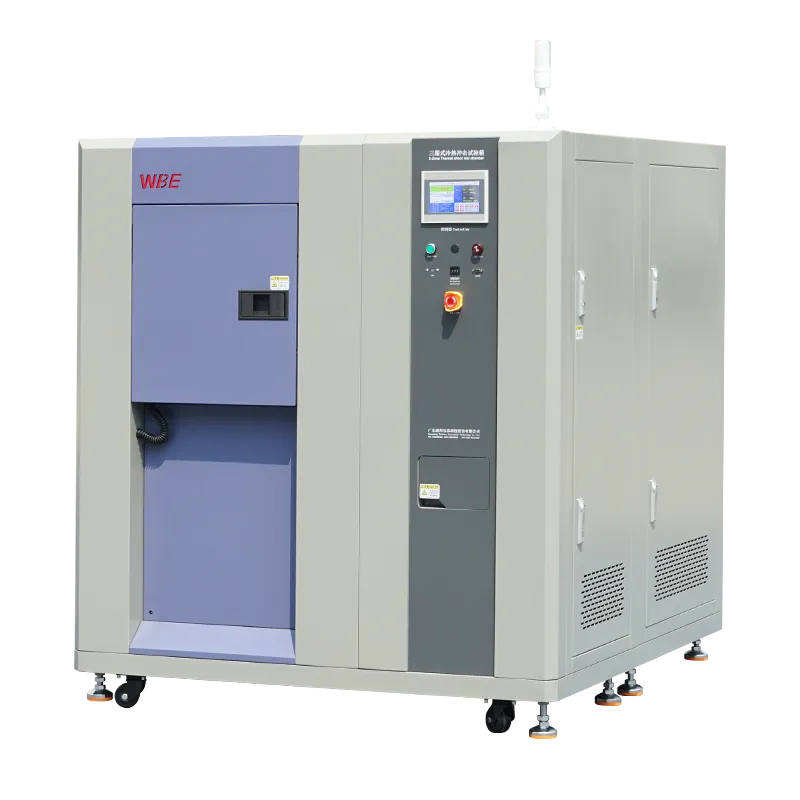
In the modern landscape of high-precision electronics manufacturing, reliability is the cornerstone of brand reputation and consumer safety. As devices become smaller, more powerful, and integrated into critical infrastructure like automotive sensors and aerospace avionics, they are subjected to increasingly harsh environmental conditions. The ability of a printed circuit board (PCB) or a semiconductor component to withstand sudden, extreme shifts in temperature is a primary indicator of its long-term durability. This is where the thermal shock test chamber becomes an indispensable asset in the quality assurance laboratory. Unlike standard temperature cycling, which changes conditions gradually, a thermal shock test subjects materials to near-instantaneous transitions between hot and cold extremes, effectively exposing latent defects that would otherwise remain hidden until a catastrophic field failure occurs.
Selecting the appropriate equipment requires a deep understanding of thermodynamics, material science, and international testing standards. For manufacturers, the goal is not just to "test" but to "validate" that every solder joint, substrate layer, and packaging seal can endure the rigors of real-world application. WBE has consistently led the industry in providing high-performance environmental testing solutions, ensuring that engineers have the tools necessary to simulate these brutal environments with precision. In this comprehensive guide, we will explore the technical nuances of these chambers, the critical selection factors for electronics, and how advanced testing protocols contribute to superior product lifecycles.
The Engineering Science Behind Rapid Temperature Transitions
To appreciate the value of a thermal shock test chamber, one must first understand the physical stress it imposes on a specimen. When a component moves from a 150 degree Celsius environment to a minus 65 degree Celsius environment in less than ten seconds, it experiences significant "mismatch stress." Materials within the component, such as silicon, copper, and epoxy resins, all have different Coefficients of Thermal Expansion (CTE). As they expand and contract at varying rates during the shock, internal stresses build up at the interfaces. If the design is flawed or the manufacturing process is inconsistent, these stresses lead to micro-cracking, delamination, or open circuits.
Advanced chambers are typically designed as either two-zone or three-zone systems. In a two-zone system, the product is moved via a high-speed elevator between a hot and cold chamber. In a three-zone configuration, the product remains stationary in a middle chamber, while high-velocity air is diverted from separate hot and cold reservoirs. This prevents mechanical vibration from affecting the test results and is often preferred for fragile semiconductor wafers or complex assemblies. WBE specializes in optimizing these airflow patterns to ensure that the "recovery time"—the time it takes for the specimen's surface to reach the target temperature—is minimized, adhering to the strictest industry requirements.
Furthermore, the precision of the control system cannot be overstated. A high-quality thermal shock test chamber must maintain extreme stability at both ends of the spectrum. Even a slight deviation in the dwell time or the peak temperature can invalidate a test run, leading to false passes or unnecessary redesigns. By utilizing PID (Proportional-Integral-Derivative) controllers and high-sensitivity sensors, modern chambers provide the granularity needed for modern 3C (Computer, Communication, and Consumer electronics) validation, where tolerances are measured in fractions of a millimeter.
Critical Selection Criteria for Electronics Manufacturers
When sourcing a thermal shock test chamber, the first consideration must be the internal dimensions and the load capacity. It is a common mistake to choose a chamber based solely on the physical size of the DUT (Device Under Test). In reality, the air circulation volume is just as important. If the chamber is overcrowded, the air cannot flow freely around the specimens, creating "dead zones" where the actual temperature transition is much slower than the programmed setpoint. This results in inconsistent data across the batch. It is generally recommended that the test load does not exceed 30% to 50% of the basket's volume to ensure uniform thermal exposure.
Temperature range and recovery time are the next vital metrics. Most electronics testing requires a range from -40°C to +125°C, but specialized aerospace components may require -65°C to +150°C. The "Recovery Time" is the most demanding specification; many MIL-STD (Military Standard) tests require the air temperature to return to the setpoint within 5 minutes after the load is introduced. This requires a robust refrigeration system, often utilizing a cascade compressor setup and high-efficiency heat exchangers. Choosing a chamber with insufficient cooling or heating power will lead to "lazy" transitions that do not provide the necessary "shock" effect to reveal defects.
Finally, consider the ease of integration and data logging. In a modern "Smart Factory" or Industry 4.0 environment, the chamber should not be an island of data. It needs to export detailed logs that can be correlated with other failure analysis tools. Look for interfaces like Ethernet, USB, or RS-485 that allow for remote monitoring. WBE’s systems are designed with user-friendly touchscreens and comprehensive software packages that allow engineers to program complex multi-step profiles and monitor real-time graphs, ensuring every test is documented for compliance and future research.
Navigating Industry Standards: MIL-STD, IEC, and JEDEC
The use of a thermal shock test chamber is usually governed by specific international standards that dictate the parameters of the test. For instance, MIL-STD-883K Method 1011 is a common standard for microelectronic devices, outlining different "test conditions" (A through F) with varying temperature extremes. Similarly, the JEDEC JESD22-A106 standard is widely used in the semiconductor industry. Adhering to these standards is not just a matter of "following the rules"; it is about ensuring that your reliability data is comparable to others in the global supply chain. If your chamber cannot meet the specific ramp rates or dwell times defined in these documents, your product certifications may be rejected by Tier-1 buyers.
For automotive electronics, the requirements are even more stringent. The ISO 16750 standard describes the environmental loads for electrical and electronic equipment on road vehicles. Components located near the engine or exhaust system might face much more frequent and severe shocks than those in the cabin. A high-grade chamber allows the manufacturer to simulate these lifecycle stresses in a matter of days rather than years. By performing "highly accelerated stress testing" (HAST) or thermal shock, companies can calculate the "Mean Time To Failure" (MTTF) with high confidence, which is essential for managing warranty risks and liability.
Standardized testing also facilitates troubleshooting. If a component fails during a shock test, the failure mode (such as a cracked solder ball or a broken bond wire) provides immediate feedback to the design team. Without a controlled environment provided by a professional thermal shock test chamber, these failures would be intermittent and nearly impossible to replicate in a lab. Consequently, the chamber acts as an "accelerated microscope," bringing design weaknesses to the surface where they can be analyzed and rectified before mass production begins.
Why WBE is the Trusted Partner for Reliability Testing
At WBE, we understand that every manufacturing facility has unique needs. Our commitment to excellence has made us a leading global supplier of environmental test chambers. Our range of thermal shock test chamber solutions includes two-slot, three-slot, and liquid-to-liquid variants, designed to handle everything from small SMD components to large-scale automotive modules. We don't just sell equipment; we provide complete testing ecosystems. Our chambers are engineered for energy efficiency, low noise, and maximum uptime, ensuring that your ROI is realized through higher product quality and reduced field returns.
Our product portfolio is extensive, covering various specialized needs. For those requiring rapid air-to-air transitions, our two-slot thermal shock test chamber offers high-efficiency elevator movement for maximum throughput. For more complex testing protocols that require a "dwell" period at ambient temperature, the three-slot thermal shock test chamber is the ideal choice. We also offer specialized solutions like the liquid tank thermal shock test chamber for components that require even faster heat transfer rates than air can provide.
WBE's advantage lies in our deep technical expertise and our focus on customer support. From the initial consultation where we help you define your specifications to the installation and calibration phase, our team is with you every step of the way. We also offer a wide array of other equipment such as HAST aging test chambers and bond tester machines, providing a one-stop shop for electronics reliability. By integrating our thermal shock test chamber into your workflow, you are investing in a future of zero-defect manufacturing.
Choosing WBE means choosing a partner with a proven track record. We serve a diverse range of industries, including semiconductors, new energy vehicles, and 5G communications. Our equipment is built to last, using premium components from world-renowned brands for compressors, valves, and controllers. This ensures that when you run a test, you can trust the results, time and time again. Explore our full range of products at our product gallery and see how we can elevate your quality control standards.
Conclusion: Ensuring a Resilient Future
The role of the thermal shock test chamber in the electronics industry will only continue to grow as devices become more sophisticated and consumer expectations rise. By subjecting products to the extremes of temperature in a controlled, repeatable environment, manufacturers can move beyond guesswork and build truly resilient technology. Whether you are a startup looking to validate your first prototype or an established multinational optimizing a mass-production line, the right testing partner makes all the difference. WBE is dedicated to providing the precision, reliability, and innovation needed to meet these challenges head-on, ensuring that your products can stand the test of time and environment.
Frequently Asked Questions
Q1: What are the primary benefits of using a thermal shock test chamber in electronics?
The main benefit is the rapid identification of latent manufacturing defects such as poor solder joints, internal delamination, and material mismatch issues. By simulating years of environmental stress in just a few days, it helps prevent expensive field failures and protects the brand's reputation for quality.
Q2: How does a three-zone thermal shock test chamber differ from a two-zone model?
In a two-zone chamber, the specimen moves between hot and cold zones via an elevator. In a three-zone thermal shock test chamber, the specimen remains stationary in a test zone, and air from separate hot and cold chambers is blown into the test zone. Three-zone systems are better for fragile samples that cannot handle the vibration of movement.
Q3: How do I determine the right size for my thermal shock test chamber?
You should calculate the total volume of your test samples and ensure they do not occupy more than 30-50% of the basket's capacity. This allows for sufficient airflow and ensures that the temperature recovery time meets the requirements of standards like MIL-STD or IEC.
Q4: Why is recovery time so critical in a thermal shock test chamber?
Recovery time is the duration it takes for the chamber air or the sample surface to return to the setpoint after a transition. If the recovery is too slow, the "shock" effect is lost, and the test becomes a standard temperature cycle, which may not reveal the same types of failure modes.
Q5: Can a thermal shock test chamber perform standard temperature humidity tests?
Most thermal shock chambers are specialized for rapid temperature transitions and do not include humidity control. For humidity testing, you would typically use a dedicated high and low temperature humidity test chamber, though some custom hybrid systems do exist for specific industrial applications.
Ready to Enhance Your Product Reliability?
Contact WBE today for a professional consultation and custom testing solutions tailored to your industry needs.