


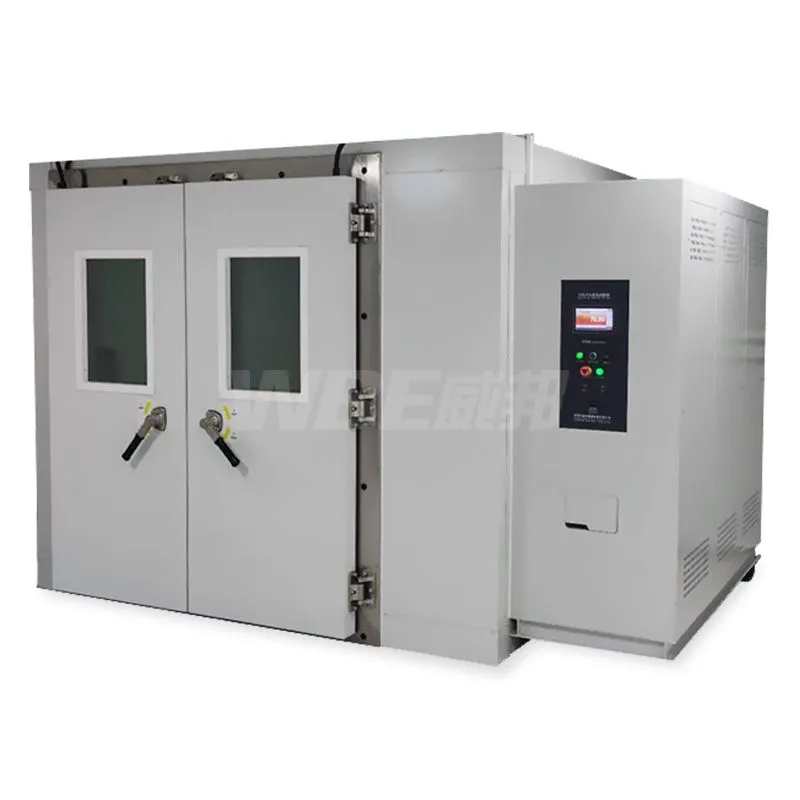
Understanding Large-Scale Environmental Simulation
In the modern industrial landscape, the reliability of products under extreme conditions is non-negotiable. For manufacturers in the aerospace, automotive, and telecommunications sectors, standard benchtop chambers often fall short when testing large-scale components or entire systems. This is where walk-in environmental chambers become indispensable. These massive testing facilities allow engineers to simulate real-world climates, ranging from arctic freezes to tropical humidity, all within a controlled laboratory environment. WBE has been at the forefront of this technology, providing high-precision solutions that cater to the most demanding testing protocols.
The core of any walk-in chamber lies in its ability to maintain absolute stability across a large volume of space. Unlike smaller units, walk-in environmental chambers must account for significant air mass, heat loads from the test samples, and the structural integrity of the insulated room itself. At WBE, our engineering philosophy centers on balancing high-performance cooling and heating with sophisticated airflow dynamics. This ensures that every corner of the chamber reflects the intended test parameters, providing data that engineers can trust for mission-critical applications.
The Mechanics of Temperature Regulation
Temperature control in large-scale chambers requires a robust refrigeration system and a responsive heating array. In professional walk-in environmental chambers, we utilize multi-stage compressor systems, often employing cascade refrigeration for ultra-low temperature requirements. These systems are designed to pull down temperatures rapidly while maintaining energy efficiency. The heating elements, usually high-grade stainless steel heaters, provide the necessary thermal energy to simulate desert heat or to recover temperature quickly after a door opening.
The integration of PID (Proportional-Integral-Derivative) control logic is what separates basic equipment from professional-grade testing tools. WBE chambers use advanced PLC controllers that constantly monitor sensor feedback, adjusting the cooling and heating outputs in real-time. This prevents the "overshoot" common in lesser systems, ensuring that the internal environment remains within a fraction of a degree of the set point. For industries like semiconductor manufacturing, where even a slight deviation can invalidate a test, this level of precision is the gold standard that WBE consistently delivers.
Furthermore, the insulation of the chamber walls plays a critical role. We utilize high-density polyurethane foam sandwiched between stainless steel plates, creating a thermal barrier that minimizes heat leakage. This structural integrity ensures that the environmental systems are not overworked, leading to longer equipment life and more stable testing conditions. Whether you are performing steady-state soaking or complex thermal cycling, the thermal management system is engineered to handle high-wattage heat loads from the products under test.
Humidity Control and Airflow Dynamics
Achieving precise humidity levels in walk-in environmental chambers is a complex engineering feat. It involves a delicate balance between moisture injection (humidification) and moisture removal (dehumidification). WBE utilizes stainless steel steam generators or ultrasonic humidifiers to introduce moisture, coupled with specialized cooling coils that act as dehumidifiers. This allows for a wide range of relative humidity simulation, from 10% to 98%, covering everything from arid dry zones to saturated salt-fog environments.
Airflow dynamics are equally critical. Without proper circulation, large chambers would suffer from "stratification," where hot air rises and cold air sinks, creating inconsistent test results. WBE solves this through custom-designed centrifugal fan systems and adjustable air louvers. These systems create a "curtain" of air that moves uniformly across the test area. By optimizing the air velocity, we ensure that the heat exchange between the air and the test sample is maximized, leading to more accurate simulation of environmental stress.
For specialized applications, such as battery testing or chemical storage, we also integrate gas detection and ventilation systems. This adds a layer of safety, ensuring that any volatile off-gassing is neutralized or expelled, protecting both the facility and the personnel. The synergy between humidity control and airflow is what makes our walk-in solutions the preferred choice for research and development laboratories worldwide.
Why Choose WBE for Your Environmental Testing?
With over 20 years of expertise, WBE (Dongguan Yuanyao Test Equipment Co., Ltd) has established itself as a global leader in climate simulation technology. Our commitment to innovation and quality has allowed us to serve prestigious clients, including Fortune 500 companies and state-owned aerospace enterprises. We don't just sell equipment; we provide comprehensive testing solutions tailored to your specific industrial requirements.
Our flagship walk-in environmental chambers are engineered for durability and precision. We also offer specialized equipment such as the walk-in high and low temperature wet heat test chamber for extreme cycling and the explosion-proof battery test chamber for the burgeoning EV market. At WBE, our advantage lies in our vertical integration, from R&D and design to manufacturing and after-sales support.
Customization: Tailored sizes and parameters to fit your facility perfectly.
Efficiency: Energy-saving refrigeration technology that reduces operational costs.
Compliance: All equipment meets international standards including ISO, CE, and ASTM.
Frequently Asked Questions
Q1: What are the key benefits of using walk-in environmental chambers for automotive testing?
Walk-in chambers allow for the testing of full vehicles or large sub-assemblies like dashboards and engines. This ensures that all components work harmoniously under temperature stress, preventing field failures that smaller, component-level tests might miss.
Q2: How does WBE ensure temperature uniformity in its walk-in environmental chambers?
We utilize a proprietary balanced airflow system that uses high-static pressure fans and strategically placed return ducts. This eliminates hot or cold spots, ensuring uniformity across the entire internal volume, even with high-density test loads.
Q3: Can walk-in environmental chambers be customized for specific height and width constraints?
Yes, WBE specializes in modular construction. We can design and install chambers that fit within your existing floor plan, accommodating specific doorway clearances or ceiling heights while maintaining peak performance.
Q4: What maintenance is required for long-term operation of walk-in environmental chambers?
Regular maintenance includes cleaning the condenser coils, checking refrigerant levels, calibrating sensors, and inspecting door seals. WBE provides comprehensive service contracts to ensure your chamber remains in optimal condition for years.
Q5: Are WBE walk-in environmental chambers compatible with remote monitoring?
Absolutely. Our controllers support Ethernet and RS485 connections, allowing for remote data logging, mobile app monitoring, and integration into your laboratory information management system (LIMS).
Secure Your Product Quality with WBE Solutions
Investing in high-quality walk-in environmental chambers is an investment in your brand's reputation. Don't leave your product's reliability to chance. Contact the experts at WBE today for a customized consultation.