


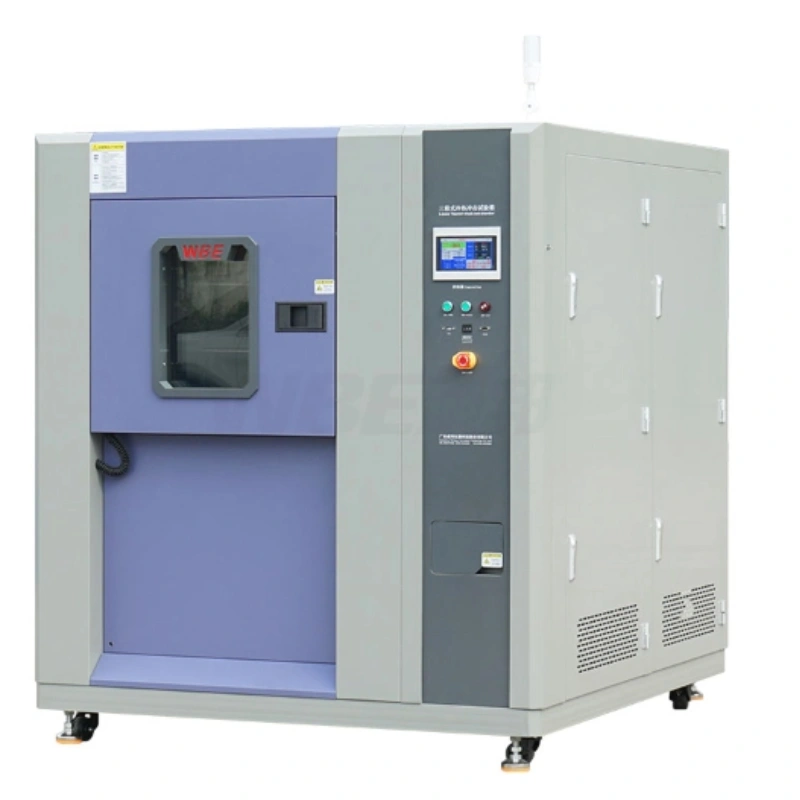
In industrial testing, both Thermal Shock Test Chambers and Environmental Test Chambers are essential for evaluating product performance under varying conditions. While both simulate environmental stress, they serve different purposes and testing requirements. Understanding their key differences helps manufacturers select the right equipment for quality control, reliability testing, and product development.
This article explains the working principles, applications, and benefits of each chamber type, highlighting their distinctions.
Thermal Shock Test Chamber Overview
Thermal Shock Test Chambers are designed to simulate rapid temperature changes to evaluate product durability. They typically consist of multiple zones: a high-temperature chamber and a low-temperature chamber. Products are rapidly transferred between these zones to create extreme thermal shock conditions.
Key Applications:
- Electronics and connectors
- Automotive components
- Aerospace modules
- Consumer and industrial products
Benefits:
- Detects material, solder, or assembly weaknesses caused by rapid temperature changes
- Accelerates failure analysis and product life testing
- Ensures product reliability under extreme operational conditions
Thermal shock chambers are ideal for products exposed to sudden temperature fluctuations, such as electronics in automotive or aerospace applications.
Environmental Test Chamber Overview
Environmental Test Chambers provide a controlled environment for testing products under stable or cyclic conditions of temperature, humidity, and sometimes vibration. Unlike thermal shock chambers, environmental chambers focus on long-term exposure rather than rapid transitions.
Key Applications:
- Electronics, semiconductors, and PCBs
- Industrial machinery and automotive systems
- Plastics, composites, and packaging materials
Benefits:
- Simulates real-world environmental conditions over extended periods
- Evaluates product performance under heat, cold, humidity, or combined stress
- Supports long-duration reliability and quality assurance testing
Environmental test chambers are suitable for assessing endurance and material performance under continuous or cyclic environmental conditions.
Key Differences Between Thermal Shock and Environmental Test Chambers
|
Feature |
Thermal Shock Test Chamber |
Environmental Test Chamber |
|
Purpose |
Simulates rapid temperature changes (thermal shock) |
Simulates controlled environmental conditions over time |
|
Temperature Change |
Very fast (seconds to minutes) |
Gradual or programmed cycles (hours to days) |
|
Stress Type |
Extreme thermal stress |
Temperature, humidity, sometimes vibration, or combined stress |
|
Typical Use |
Detecting weaknesses in solder, connectors, or assembly under sudden temperature change |
Long-term reliability testing, endurance, and environmental qualification |
|
Applications |
Electronics, automotive, aerospace, small assemblies |
Electronics, industrial machinery, plastics, composites, packaging |
|
Cycle Duration |
Short, high-frequency |
Longer, low-frequency or continuous |
While both chamber types evaluate product durability, thermal shock chambers focus on rapid and extreme stress, whereas environmental test chambers simulate long-term environmental exposure.
Choosing the Right Chamber
Selecting the correct test chamber depends on product type, expected environmental conditions, and testing objectives:
- Use Thermal Shock Chambers for components sensitive to sudden temperature changes or for accelerated failure analysis.
- Use Environmental Test Chambers for long-term performance evaluation, humidity resistance, and cyclic environmental stress testing.
- For comprehensive reliability assessment, some manufacturers combine both types to evaluate different stress scenarios.
Understanding these differences ensures accurate testing results and helps improve product durability and customer satisfaction.
About WBE Instrument Technology
Guangdong WBE Instrument Technology Co., Ltd. is a professional manufacturer of Thermal Shock Test Chambers, Environmental Test Chambers, Walk-in Chambers, and Mechanical Testing Machines.
Serving electronics, automotive, aerospace, and industrial sectors, WBE provides precise temperature control, programmable testing cycles, and robust monitoring systems. WBE’s chambers help manufacturers simulate real-world conditions, detect potential failures early, and enhance overall product reliability and quality control.
FAQ
Q1: What is the main difference between a thermal shock chamber and an environmental test chamber?
A thermal shock chamber simulates rapid temperature changes, while an environmental test chamber simulates long-term controlled temperature and humidity conditions.
Q2: Which products need thermal shock testing?
Electronics, connectors, automotive modules, aerospace components, and any product exposed to sudden temperature fluctuations.
Q3: Which products require environmental test chambers?
Electronics, industrial machinery, plastics, composites, and packaging materials requiring long-term environmental performance evaluation.
Q4: Can a product be tested in both chambers?
Yes, combining both tests provides a complete reliability assessment under both rapid and long-term environmental stress.
Q5: How do these chambers improve product reliability?
By identifying material or assembly weaknesses under different stress conditions, they help manufacturers improve design, durability, and overall product performance.