


A comprehensive guide to understanding the engineering, applications, and strategic value of large-scale climatic simulation systems in modern manufacturing.
Introduction to Large-Scale Climatic Testing
In the contemporary industrial landscape, the reliability of complex systems—ranging from electric vehicle drivetrains to aerospace avionics—is non-negotiable. As products grow in size and complexity, standard benchtop testing solutions often fall short. This is where walk-in environmental chambers become indispensable. These massive testing facilities allow engineers to subject entire assemblies, vehicles, or large batches of components to extreme temperature and humidity conditions simultaneously. By simulating the harsh realities of the physical world within a controlled environment, manufacturers can identify potential failure points early in the development cycle, ensuring long-term durability and safety.
The primary function of these chambers is to provide a stable, repeatable environment where variables like thermal stress and moisture ingress can be measured with high precision. Unlike smaller units, the design of a walk-in system must account for significant air volume, internal heat loads from the equipment under test, and the structural integrity required to maintain a seal over a vast surface area. Engineering such a space requires a deep understanding of thermodynamics and fluid dynamics to ensure that every corner of the room maintains the target parameters without "dead zones."
Structural Engineering and Design Integrity
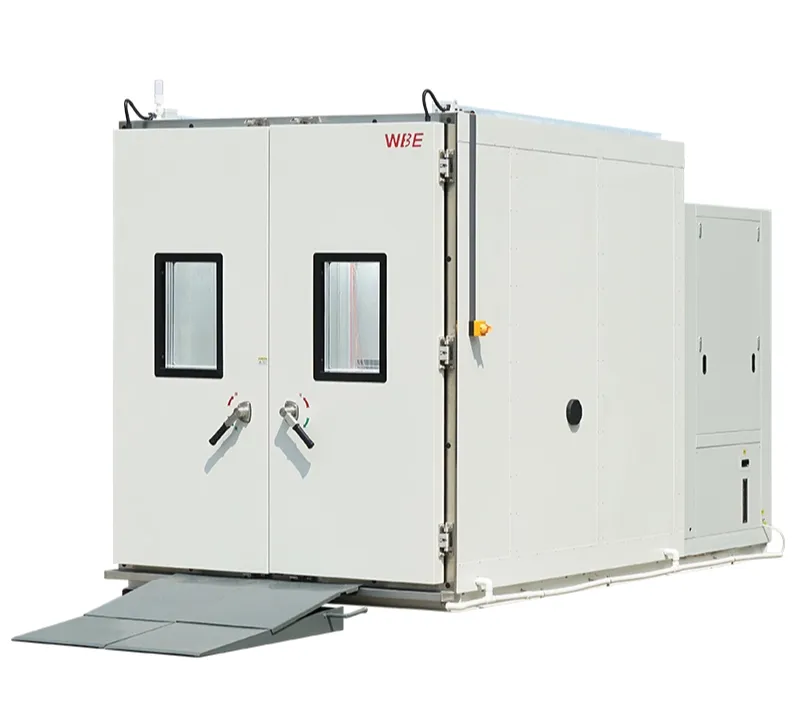
Designing high-performance walk-in environmental chambers involves more than just scaling up a small box. The structural composition typically utilizes modular sandwich panels, often filled with high-density polyurethane foam or glass wool for superior thermal insulation. The interior skin is almost universally crafted from SUS304 or SUS316L stainless steel to resist corrosion caused by high humidity and condensation. Because these chambers are large enough for personnel to enter, safety features such as internal door releases and emergency stop buttons are integrated directly into the hardware architecture.
Flooring is another critical consideration in the engineering phase. For testing heavy equipment like automotive battery packs or industrial generators, the floor must be reinforced with stainless steel plating and structural supports capable of handling several tons per square meter. Additionally, the door systems—whether single-wing, double-wing, or sliding—must utilize high-quality silicone gaskets to prevent thermal leakage. Advanced chambers also incorporate "thermal bridge" prevention techniques, ensuring that the cold or heat from the interior does not transfer through the structural frame to the exterior laboratory environment, which could cause condensation or energy loss.
Precision Control and Airflow
At the heart of every chamber is a sophisticated Control Logic system. Using PLC (Programmable Logic Controllers) and high-accuracy sensors, these chambers manage complex heating, cooling, and humidification cycles. In large-scale testing, maintaining uniformity is the biggest challenge. Specialized centrifugal fans and air ducting systems are engineered to circulate air at specific velocities, ensuring that the temperature gradient remains within narrow margins (typically within +/- 2.0 degrees Celsius) throughout the entire workspace.
Modern systems also feature remote monitoring and data logging capabilities. Engineers can track real-time graphs and receive alerts via mobile devices, allowing for 24/7 testing cycles without the need for constant physical supervision. This level of automation is essential for long-term reliability tests that may run for weeks or even months at a time.
Industry-Specific Applications
The versatility of walk-in environmental chambers makes them a staple in various high-tech sectors. In the automotive industry, they are used to perform full-vehicle climate aging, checking how interior plastics, electronics, and mechanical seals hold up under desert heat or arctic cold. With the rise of Electric Vehicles (EVs), these chambers are frequently customized with explosion-proof features to safely test large-capacity lithium-ion battery packs, which can be sensitive to thermal runaway during extreme stress testing.
The aerospace and defense sectors utilize these facilities to validate satellite components and communication arrays. In these fields, the stakes are incredibly high; a single component failure in orbit can result in the loss of a multi-billion dollar mission. By subjecting equipment to rapid temperature cycling and high humidity within a walk-in environment, aerospace engineers can simulate the transitions between ground-level conditions and the harsh upper atmosphere. Other industries, such as telecommunications and renewable energy (solar panel testing), rely on these chambers to ensure that outdoor equipment can survive decades of exposure to the elements.
WBE: Your Partner in Advanced Reliability Testing
As a leader in the environmental testing industry, WBE (Dongguan Yuanyao Test Equipment Co., Ltd) has spent years perfecting the art of large-scale simulation. We understand that every client has unique requirements, which is why our engineering team focuses on providing tailor-made solutions that exceed international standards like ISO, ASTM, and MIL-STD. Our commitment to innovation has made us a trusted provider for state-owned enterprises and global tech giants alike.
Our flagship walk-in type temperature and humidity chamber offers unparalleled precision for large-volume testing. Whether you are looking for a walk-in battery explosion-proof chamber for new energy applications or a complex walk-in combined environmental test chamber, WBE provides the expertise and hardware to ensure your products are market-ready. Our facility in Dongguan is equipped with the latest manufacturing technology to produce durable, energy-efficient equipment that stands the test of time.
Conclusion
Investing in high-quality walk-in environmental chambers is a strategic move for any manufacturer focused on long-term product excellence. These facilities provide the "final frontier" of validation, ensuring that large-scale systems can withstand the most punishing climates on Earth. From reducing warranty claims to accelerating the time-to-market, the benefits of a robust environmental testing protocol are clear. As technology continues to evolve and global quality standards become more stringent, the role of these massive testing environments will only grow in importance.
At WBE, we are dedicated to pushing the boundaries of what is possible in environmental simulation. By combining expert craftsmanship with cutting-edge control technology, we help our partners build a more reliable future.
Frequently Asked Questions
Q1: What are the typical size ranges for walk-in environmental chambers?
Walk-in chambers are highly customizable. While standard sizes might start around 8 cubic meters, they can be engineered to hundreds of cubic meters, large enough to accommodate full-size aircraft components or multiple commercial vehicles simultaneously.
Q2: How do walk-in environmental chambers maintain temperature uniformity?
Uniformity is achieved through advanced airflow design. High-volume fans circulate conditioned air through specialized plenums and adjustable louvers, ensuring that even in a large space, the temperature remains consistent across all test points.
Q3: Can walk-in environmental chambers be used for battery testing?
Yes, but they require specific safety enhancements. For EV battery testing, chambers must be equipped with explosion-proof vents, gas sensors, fire suppression systems, and reinforced structures to handle potential thermal runaway events safely.
Q4: What is the power requirement for operating walk-in environmental chambers?
Due to the large compressors and heaters required to condition massive air volumes, these chambers typically require a 3-phase industrial power supply (e.g., 380V/480V). Energy-efficient designs with frequency converters are often used to manage operational costs.
Q5: How long does it take to install walk-in environmental chambers on-site?
Since most large chambers are modular, they are shipped in sections and assembled on-site. Installation typically takes 7 to 15 days, followed by several days of commissioning and calibration to ensure the system meets the specified performance metrics.
Ready to Elevate Your Testing Standards?
Contact the WBE technical team today for a custom consultation on your next environmental testing project.
Request a Quote