


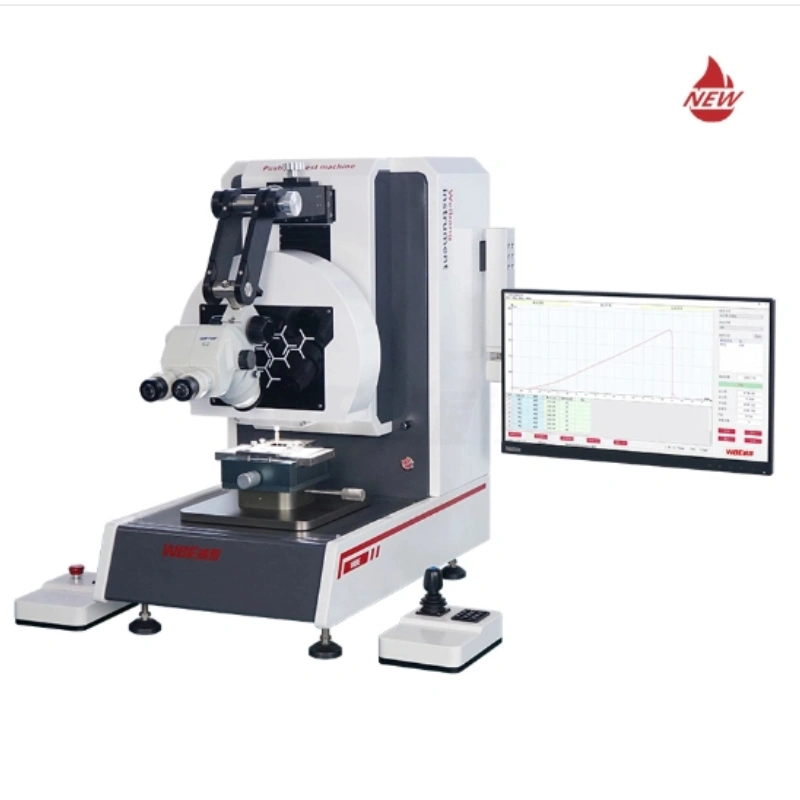
In the rapidly evolving world of electronics manufacturing, the reliability of individual components determines the success of the entire system. Among these components, connectors play a pivotal role in ensuring seamless data transmission and power supply. To guarantee that these parts can withstand the rigors of daily use and extreme environments, engineers rely heavily on specialized equipment. A Push-pull Testing Machine is the cornerstone of this quality assurance process. This high-precision instrument is designed to measure the mechanical strength of various joints, including wire bonds, solder balls, and connector interfaces.
By simulating the physical stresses of insertion and extraction, the machine provides critical data regarding the durability and structural integrity of a product. At WBE, we understand that even a minor failure in a semiconductor or a connector can lead to catastrophic system downtime. Therefore, utilizing a robust push-pull testing machine is not just a procedural step but a strategic necessity for any manufacturer aiming for excellence in the 3C, automotive, or aerospace sectors.
Understanding the Mechanism of a Push-pull Testing Machine
The fundamental operation of a push-pull testing machine revolves around precision force application and high-resolution measurement. These machines are typically equipped with advanced load cells that can detect minute changes in resistance, often down to the milligram level. The "push" aspect usually refers to compression or shear testing, where a probe applies force to a component to determine its breaking point or displacement threshold. Conversely, the "pull" aspect involves tensile testing, commonly used to check the bond strength of gold or aluminum wires in semiconductor packaging.
Modern iterations, such as those developed by WBE, integrate multi-axis motion control. This allows the machine to move with incredible accuracy in X, Y, and Z directions, ensuring that the probe aligns perfectly with the target area. The software component of the push-pull testing machine translates these physical movements into real-time graphs and data points. Engineers can analyze the peak force, mean force, and failure modes through dedicated algorithms. This level of detail is essential for identifying whether a failure occurred due to material fatigue, poor soldering, or design flaws in the connector housing itself.
Furthermore, the versatility of these machines is enhanced by interchangeable modules. Depending on the specific requirements of the test, operators can switch between wire pull hooks, shear tools, and specialized tweezers. This modularity ensures that a single push-pull testing machine can serve multiple roles across a production line, significantly reducing capital expenditure while maintaining high testing standards across various product categories.
Critical Role of the Push-pull Testing Machine in Connector Reliability
Connectors are designed to be mated and unmated hundreds, if not thousands, of times over their lifecycle. A primary concern for manufacturers is the "insertion force" and "withdrawal force." If the insertion force is too high, the user experience suffers, and there is a risk of damaging the internal pins. If the withdrawal force is too low, the connection may become loose under vibration, leading to intermittent signal loss. A push-pull testing machine provides the empirical evidence needed to balance these forces during the design phase.
In the context of high-speed data connectors, physical stability is directly linked to electrical performance. Any deformation caused by mechanical stress can alter the impedance of the connection, resulting in signal degradation. By utilizing a push-pull testing machine, quality control teams can conduct life-cycle testing, subjecting the connector to repeated mechanical cycles and measuring the degradation of force over time. This helps in predicting the lifespan of the product and setting realistic warranty periods.
Moreover, in automotive and aerospace applications, connectors must withstand harsh environmental conditions. The mechanical testing often goes hand-in-hand with environmental stress tests. For instance, a connector might be tested on a push-pull testing machine after being subjected to thermal shock or high humidity. This integrated approach ensures that the mechanical bonds remain strong even after the materials have expanded or contracted due to temperature fluctuations, a specialty that WBE supports through its comprehensive range of environmental and mechanical testers.
Advanced Features and Technical Accuracy Requirements
Accuracy is the most critical attribute of any push-pull testing machine. For micro-electronic applications, the machine must offer sub-micron positioning accuracy. This is achieved through the use of high-grade servo motors and optical encoders that provide constant feedback to the control system. When testing delicate wire bonds, the slightest overshoot in force can lead to false readings or unnecessary damage to the wafer. Therefore, the machine's ability to stop instantly upon detecting a "break" is a hallmark of high-end equipment.
Another significant feature is the automation capability. Manual testing is prone to human error and is often too slow for modern high-volume manufacturing. Automated push-pull testing machines can be programmed to recognize patterns on a PCB or a lead frame using high-definition cameras and pattern recognition software. This allows for rapid, unattended testing of hundreds of points, ensuring statistically significant data sets that can be used for Six Sigma quality improvements.
Data integrity and traceability are also paramount. In industries like medical device manufacturing or defense, every test result must be logged and archived for years. Modern push-pull testing machine software includes robust database management systems that record the date, time, operator, and exact parameters of every test. This traceability ensures that if a field failure occurs, engineers can trace back the specific production batch and identify if there were any anomalies during the mechanical validation phase.
Expanding Applications Across Diverse Industrial Sectors
While often associated with semiconductors, the utility of the push-pull testing machine extends far beyond. In the electric vehicle (EV) industry, these machines are used to test the strength of battery tab welds and high-voltage busbars. Given the safety implications of a loose connection in an EV battery pack, the precision provided by these testers is non-negotiable. The ability to handle high-load capacities while maintaining sensitivity for small components makes them indispensable for green energy technologies.
In the consumer electronics market, specifically for smartphones and wearables, the push-pull testing machine is used to validate the adhesion of displays, the durability of buttons, and the strength of miniature charging ports. As devices become thinner and more compact, the internal components become more crowded, making the precision of mechanical testing even more critical. WBE's machines are designed to meet these challenges, offering the delicate touch required for micro-components and the power needed for larger assemblies.
Finally, the research and development phase of new materials benefits immensely from these machines. When developing new conductive adhesives or lead-free solders, researchers use a push-pull testing machine to compare the mechanical properties of different formulations. This empirical data accelerates the innovation cycle, allowing companies to bring more reliable and advanced products to market faster than their competitors.
About WBE: Your Partner in Testing Excellence
WBE (Dongguan Yuanyao Test Equipment Co., Ltd) has been at the forefront of the environmental and mechanical testing industry since its inception. We specialize in providing high-end solutions that help global manufacturers ensure product durability and safety. Our expertise spans across climate simulation and mechanical force validation, making us a comprehensive partner for quality assurance.
Our flagship Push-pull Testing Machine series is recognized for its multi-module flexibility and extreme precision. Whether you are looking for a bond tester machine for semiconductor production or an electronic universal testing machine for material analysis, WBE provides the technology to drive your business forward.
We pride ourselves on our technical support and customized solutions. From walk-in chambers to specialized chip shearing push-pull testing machines, WBE ensures your testing lab is equipped for the future.
Frequently Asked Questions
Q1: How often should a Push-pull Testing Machine be calibrated?
Most industry standards, such as ISO and MIL-STD, recommend that a push-pull testing machine be calibrated at least once a year. However, in high-intensity production environments where the machine runs 24/7, semi-annual calibration is advised to ensure force measurement accuracy remains within 0.5% of the full scale.
Q2: Can a Push-pull Testing Machine handle both micro-welds and large connectors?
Yes, many advanced machines feature a modular design. By swapping the load cell and the test head, the same push-pull testing machine can transition from testing 15-micron gold wires to testing heavy-duty automotive connectors requiring hundreds of Newtons of force.
Q3: What software features are essential for a modern Push-pull Testing Machine?
Essential features include real-time force-displacement curve plotting, automatic failure mode categorization, statistical analysis (CPK/PPK), and full data export capabilities for ERP/MES integration. This allows the push-pull testing machine to be an active part of the smart factory ecosystem.
Q4: Is specialized training required to operate a Push-pull Testing Machine?
While basic operation is intuitive, advanced programming for automated testing sequences does require training. WBE provides comprehensive onsite training and technical manuals to ensure your team can maximize the potential of your push-pull testing machine from day one.
Q5: How does a Push-pull Testing Machine contribute to cost savings?
By identifying defects early in the production cycle, a push-pull testing machine prevents the costly assembly of faulty components. It reduces scrap rates, minimizes the risk of product recalls, and helps optimize material usage, providing a significant return on investment (ROI).
Elevate Your Quality Standards with WBE
Don't leave your product's reliability to chance. Invest in a high-precision push-pull testing machine from WBE today and ensure every connection is built to last.