


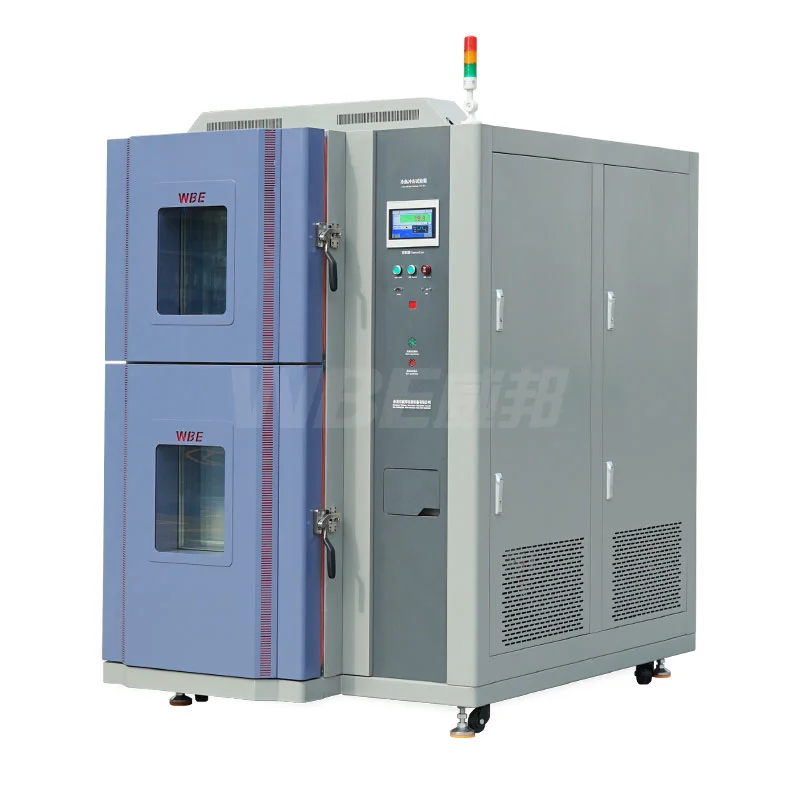
In the modern manufacturing landscape, ensuring product durability under extreme conditions is not just an advantage; it is a necessity. A thermal shock test chamber serves as a critical tool for engineers to simulate rapid temperature transitions that materials might encounter during their lifecycle.
Understanding the Thermal Shock Test Chamber and Its Purpose
A thermal shock test chamber is a highly specialized environmental testing apparatus designed to expose products to alternating high and low temperatures in a matter of seconds. Unlike standard temperature cycling, which changes temperature gradually, a thermal shock test chamber focuses on "shocks"—sudden, drastic shifts that test the physical limits of expansion and contraction in various materials.
At WBE, we understand that reliability is the cornerstone of any successful product. Whether it is a tiny semiconductor component or a complex automotive sensor, materials behave differently when subjected to thermal stress. The primary goal of using a thermal shock test chamber is to induce failures caused by mismatched coefficients of thermal expansion (CTE) between different parts of a product. By doing so, manufacturers can identify latent defects such as cracking, delamination, or seal failures before the product ever reaches the consumer.
The industry demand for such precision has led to the development of sophisticated equipment that can transition from -65 degrees Celsius to +150 degrees Celsius almost instantaneously. This rigorous testing environment mimics real-world scenarios like aerospace components moving through different atmospheric layers or electronics operating in extreme climates.
How a Thermal Shock Test Chamber Operates
The operational principle of a thermal shock test chamber revolves around two or three distinct zones: a high-temperature chamber, a low-temperature chamber, and sometimes a neutral ambient zone. The way the specimen moves between these zones defines the type of chamber and the intensity of the shock.
The Two-Zone Design Mechanism
In a two-zone thermal shock test chamber, the system utilizes a motorized basket that physically carries the test samples between the hot and cold compartments. This mechanical transfer happens rapidly, usually within 10 seconds or less. As the basket moves, the specimen experiences a near-instantaneous change in environment, forcing the material to adapt immediately to the new thermal state.
The Three-Zone Design Mechanism
The three-zone thermal shock test chamber adds an ambient temperature stage. Instead of moving the sample, some three-zone systems move the air. High-speed dampers or valves redirect pre-heated or pre-cooled air into the test area. This allows for a period of ambient recovery between the extreme hot and cold peaks, which is a requirement for certain MIL-STD or JEDEC testing protocols.
Both designs require high-efficiency refrigeration systems and precision-controlled heating elements. The control system is the brain of the thermal shock test chamber, ensuring that the "recovery time"—the time it takes for the specimen's temperature to stabilize after a shock—is kept to an absolute minimum to maintain test integrity.
Critical Applications and Industry Importance
The use of a thermal shock test chamber is prevalent in industries where failure is not an option. For instance, in the electronics sector, solder joints are particularly vulnerable to thermal fatigue. When a PCB (Printed Circuit Board) undergoes rapid temperature changes, the different expansion rates of the substrate and the metal components can lead to micro-cracks. A thermal shock test chamber helps in validating the integrity of these joints over thousands of cycles.
In the automotive industry, as vehicles become more reliant on electronic control units (ECUs) and sensors, the necessity for a thermal shock test chamber has grown. These components must survive the transition from a cold start in a sub-zero garage to the intense heat generated by the engine during operation. Testing these components ensures that the safety systems of the vehicle remain operational regardless of the weather conditions.
Furthermore, the defense and aerospace sectors utilize the thermal shock test chamber to comply with stringent quality standards. Components for satellites, missiles, and high-altitude aircraft are exposed to some of the most violent temperature shifts known to man. Without the data provided by a high-quality thermal shock test chamber, the risk of mission failure would be unacceptably high.
Technical Solutions and Strategic Insights
Selecting the right thermal shock test chamber requires a deep understanding of your testing requirements. Factors such as the size of the test specimen, the required temperature range, and the specific transition time must be considered. A larger load requires a more powerful refrigeration system to achieve the same recovery time as a smaller load.
At WBE, we provide strategic solutions that go beyond just selling equipment. We focus on energy-efficient designs and user-friendly interfaces. Modern thermal shock test chamber systems now include remote monitoring capabilities and data logging software that allows engineers to track the progress of a test from anywhere in the world. This integration of IoT technology ensures that the testing process is not only accurate but also highly efficient in terms of labor and energy consumption.
Maintenance is another critical aspect. Since the thermal shock test chamber undergoes extreme stress itself, high-quality construction materials are essential. Using stainless steel liners and high-grade insulation prevents the chamber's own structure from deteriorating due to the same thermal shocks it is delivering to the test samples.
Benefits of Investing in High-Quality Testing Equipment
The primary benefit of utilizing a professional thermal shock test chamber is the reduction of time-to-market. By accelerating the aging process, manufacturers can compress years of environmental wear into a few weeks of testing. This allows for rapid iteration of product designs and faster validation of new materials.
- Enhanced Reliability: Identify and eliminate weaknesses early in the design phase.
- Cost Savings: Reduce the high costs associated with product recalls and warranty claims.
- Compliance: Meet international standards such as ISO, ASTM, and MIL-STD using a calibrated thermal shock test chamber.
- Customer Trust: Deliver products that are proven to withstand the harshest environments.
About WBE: Your Partner in Reliability
Dongguan Yuanyao Test Equipment Co., Ltd, known globally as WBE, is a premier manufacturer specializing in high-end environmental testing solutions. With a commitment to innovation and quality, WBE has established itself as a leader in the production of the thermal shock test chamber and other reliability testing equipment. Our expertise spans across multiple industries, including semiconductors, new energy, and aerospace.
Our product lineup is designed to meet the most demanding specifications. For instance, our two-slot thermal shock test chamber offers unmatched transition speeds and temperature stability. For larger scale operations, we offer the three-slot thermal shock test chamber, which provides the flexibility of an ambient stage.
WBE's advantage lies in our technical precision and customer-centric approach. Each basket-type hot and cold shock test chamber we produce undergoes rigorous quality control to ensure it delivers accurate and repeatable results. Beyond thermal shock, we provide a full suite of equipment including hast test chambers and mechanical testing machines to cover all aspects of product validation.
Frequently Asked Questions
Q1: What is the main difference between a thermal shock test chamber and a temperature cycling chamber?
The primary difference is the rate of temperature change. A temperature cycling chamber changes temperature gradually (usually 1 to 15 degrees per minute), whereas a thermal shock test chamber transitions between temperature extremes in seconds, creating a much higher level of thermal stress.
Q2: How often should a thermal shock test chamber be calibrated?
To ensure accurate results, a thermal shock test chamber should ideally be calibrated at least once a year. However, if it is used for high-frequency or critical aerospace testing, semi-annual calibration may be required to maintain compliance with international standards.
Q3: Can a thermal shock test chamber test liquid-to-liquid transitions?
Yes, there are specialized types of equipment known as liquid-to-liquid thermal shock test chamber units. These use fluids with high thermal conductivity to provide an even more severe shock than air-to-air chambers, often used for specific hermetic seal testing.
Q4: What safety features should a modern thermal shock test chamber include?
A modern thermal shock test chamber must include over-temperature protection, emergency stop buttons, pressure relief valves for the refrigeration system, and door interlocking mechanisms to prevent injury during the rapid movement of the internal basket.
Q5: How does the load size affect the performance of a thermal shock test chamber?
The mass of the test specimen directly impacts the recovery time. If the load is too large for the thermal shock test chamber capacity, it will take longer for the air temperature to return to the set point after a shock, which can invalidate certain test standards that require strict recovery windows.
Ready to Elevate Your Quality Standards?
Partner with WBE for the most reliable and precise thermal shock testing solutions in the industry.