


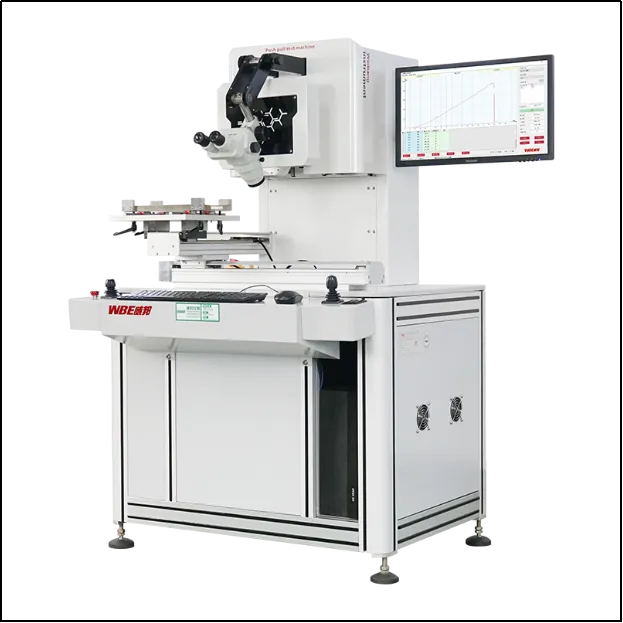
In the electronics and automotive industries, connectors play a crucial role in ensuring reliable electrical connections. The performance and durability of connectors under mechanical stress are critical for product safety and longevity. Push-Pull Testing Machines are specialized devices used to evaluate the tensile and compressive strength of connectors, providing accurate measurements for quality control and reliability testing.
This article explores the working principle of push-pull testing machines in connector testing, their applications, and the advantages they bring to manufacturers and testing laboratories.
Understanding Connector Testing
Connectors are subject to various mechanical forces during installation, operation, and maintenance. Common stresses include:
- Pull-out force during cable disconnection
- Compression when connectors are inserted or mated
- Lateral stress from bending or misalignment
Ensuring connectors can withstand these forces is essential to prevent connection failures, signal loss, or safety hazards. Push-pull testing machines provide a controlled and repeatable method to measure these mechanical properties.
Working Principle of Push-Pull Testing Machines
Push-pull testing machines operate on a simple yet precise mechanical principle:
- Sample Clamping: The connector or component is securely fixed in the machine’s grips or fixtures to prevent slippage.
- Force Application: A motorized or hydraulic system applies a tensile (pull) or compressive (push) force along a specified axis.
- Force Measurement: Load cells or force sensors record the applied force in real-time.
- Displacement Monitoring: The movement or elongation of the connector is measured to determine material deformation or failure points.
- Data Analysis: The machine’s software generates force-displacement curves, peak load values, and other mechanical performance metrics.
This working principle allows engineers to evaluate both pull-out strength and insertion force, ensuring connectors meet industry specifications and reliability requirements.
Applications in Connector Testing
Push-pull testing machines are widely used in connector testing across industries:
1. Electrical and Electronic Connectors
Testing the tensile and compressive strength of wire-to-board, wire-to-wire, and board-to-board connectors ensures reliable electrical connections in electronics assemblies.
2. Automotive Connectors
Automotive connectors are exposed to vibration, thermal expansion, and mechanical stress. Push-pull testing ensures they can withstand repeated mating and unmating cycles without failure.
3. Aerospace and Defense
High-reliability connectors used in aerospace systems must pass stringent mechanical testing, including push-pull tests, to guarantee safe and stable connections under extreme conditions.
4. Consumer Electronics
Push-pull testing helps manufacturers ensure that connectors in devices like smartphones, computers, and appliances maintain durability and user safety.
Advantages of Push-Pull Testing Machines
Precise Force Measurement
Push-pull testing machines provide accurate measurement of insertion and extraction forces, enabling reliable evaluation of connector performance.
Repeatable and Consistent Testing
Automated testing cycles ensure consistent results, reducing human error and improving data reliability for quality control.
Early Defect Detection
Identifying weak connectors during production prevents failures in the field, reducing warranty claims and customer complaints.
Support for Industry Standards
Push-pull testing machines help manufacturers comply with standards such as IEC, UL, and automotive connector specifications.
Versatile Applications
Beyond connectors, these machines can also test cables, fasteners, terminals, and small mechanical components, making them highly adaptable in quality control laboratories.
Best Practices in Connector Testing
- Proper Fixture Selection: Use fixtures designed for the specific connector type to prevent slippage and ensure accurate results.
- Controlled Testing Speed: Set appropriate pull and push speeds to simulate real-world conditions.
- Calibration: Regularly calibrate force sensors to maintain measurement accuracy.
- Data Analysis: Review force-displacement curves and peak load values to identify potential mechanical weaknesses.
Following these practices ensures accurate, repeatable, and meaningful testing results.
About WBE Instrument Technology
Guangdong WBE Instrument Technology Co., Ltd. is a leading provider of precision testing equipment, including Push-Pull Testing Machines, Universal Testing Machines, Mechanical Testing Machines, and Environmental Test Chambers.
With over two decades of experience, WBE serves industries such as electronics, automotive, aerospace, and consumer products. WBE’s push-pull testing machines offer precise force measurement, programmable cycles, and robust fixtures, helping manufacturers ensure reliable connector performance, enhance product safety, and maintain high-quality standards.
FAQ
Q1: What is a Push-Pull Testing Machine?
A Push-Pull Testing Machine is a device that applies controlled tensile (pull) or compressive (push) forces to components, measuring their mechanical strength and durability.
Q2: Why are push-pull tests important for connectors?
They evaluate the insertion and extraction forces, ensuring connectors remain reliable and safe under repeated use.
Q3: What industries use push-pull testing machines for connector testing?
Electronics, automotive, aerospace, and consumer products industries use push-pull testing to verify connector performance and compliance with standards.
Q4: How does a push-pull testing machine measure force?
The machine uses load cells or force sensors to accurately record the applied tensile or compressive force during the test.
Q5: How often should push-pull testing machines be calibrated?
Calibration should follow manufacturer guidelines and industry standards to ensure precise and reliable measurement results.